Start Horseback Riding as an Adult: Costs, Timeline and What Year One Actually Looks Like
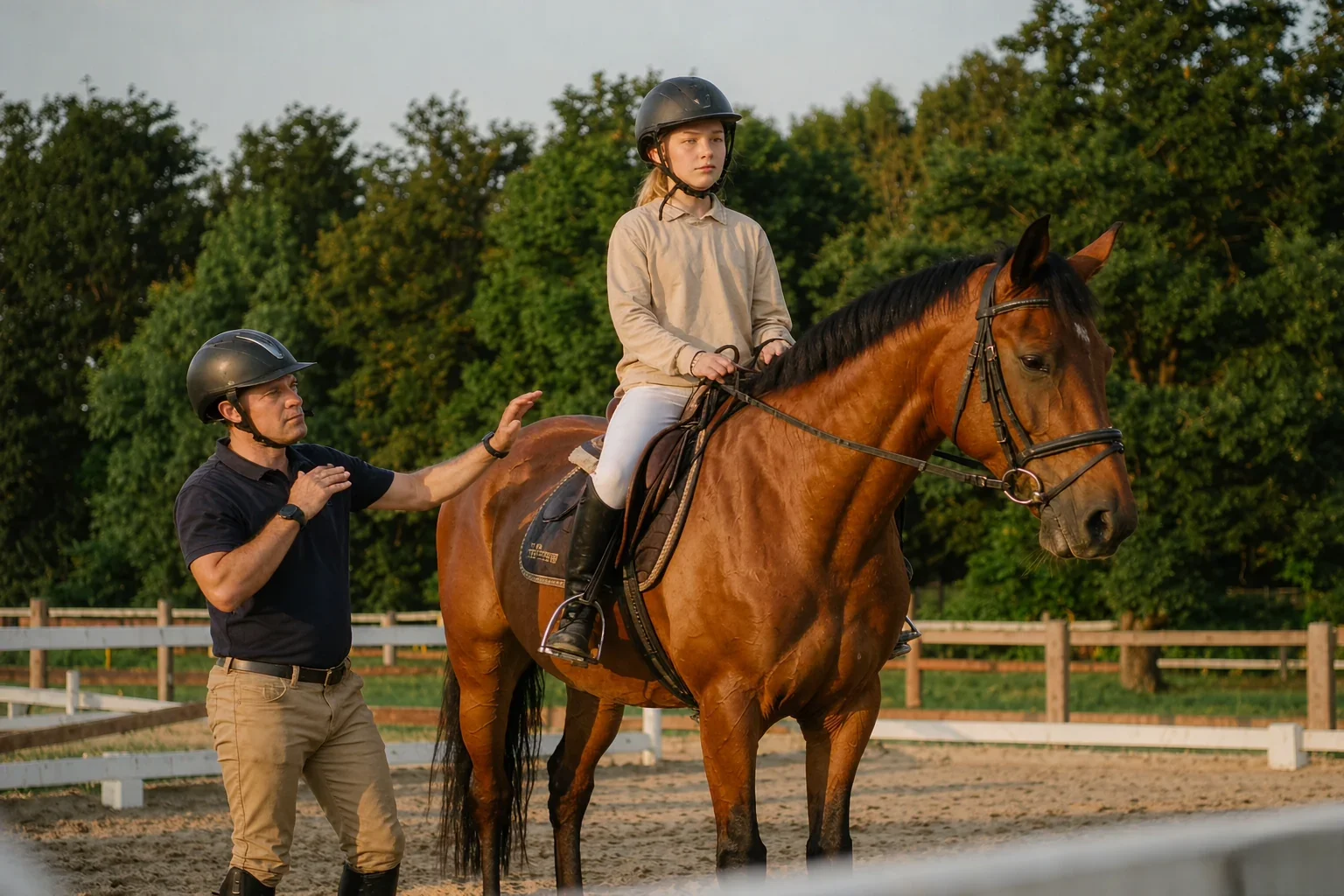
Adults start riding at 30, 45 and 60, and the barn full of teenagers is largely a myth — riding schools are built around adult beginners because adults pay for lessons reliably and keep showing up. Here is what year one actually contains: the fear, the fitness, the $40–$80 an hour, and the month-by-month timeline from your first walk to your first canter.
- Adults learn the walk-trot stage as fast as kids; the real difference is fear management, not coordination
- Weekly group lessons run $40–$80 an hour in 2026; a realistic first year lands at $2,000–$3,600 all-in
- The first canter usually arrives between lesson 12 and 24; an independent seat takes 6–12 months of consistent riding
- Many lesson programs cap riders at 200–250 lb — a horse-weight question, not a judgement. Ask before booking
- You never need to buy a horse in year one. School horses and leasing exist precisely so you do not
Not too old
The fear part
The fitness part
Year one timeline
What it costs
How often to ride
Choosing the barn
Month twelve
Most adult beginners arrive with the same private worry: that they are the oldest person in the arena, the least coordinated, and about to embarrass themselves in front of twelve-year-olds with better posture. The data says otherwise. The 2025 AHP owner survey found over half of horse owners now earn more than $100,000 — and a growing share of them started riding as adults. Riding schools know this. The beginner program is not a concession to you; it is the business model.
You Are Not Too Old, and Here Is What Actually Changes
Coordination is not the adult disadvantage. Watch a children’s class and an adult class in the same week and the adults learn steering faster — they can follow an instruction like “inside leg, outside rein” without translating it first, and they take feedback without collapsing.
Three things genuinely are different at 40 than at 12:
- Fear. A child falls off, cries, and gets back on. An adult falls off, spends a week replaying it, and arrives at the next lesson braced. Managing that loop — not bravery, management — is the actual adult skill.
- Recovery. Your thighs will complain for the first month no matter your age, and a 45-year-old back has opinions about sitting trot that a 12-year-old back does not. This is a scheduling problem, not a ceiling.
- Time. Adults book lessons around jobs and commutes, which means progress depends on consistency more than talent. Twice a week for three months beats once a week for six.
The Fear Part
Almost every adult beginner is more scared than they admit, and the fear has a shape: it is not “I will get hurt,” it is “I will not be able to control a 1,100 lb animal and something bad will happen and it will be my fault.”
Three things genuinely reduce it, in order of usefulness:
- A calm school horse. Lesson programs select their beginner horses for exactly this temperament. When you ride a horse that has ignored a thousand dropped reins, your nervous system recalibrates within about three lessons.
- An instructor who teaches adults. Ask directly: “How many of your students started as adults, and do you teach nervous riders?” A good answer includes a plan, not reassurance.
- Groundwork before mounting. Leading, grooming and tacking your horse for the first few lessons sounds like a delay. It is the opposite — it converts the animal from a force of nature into a specific horse with habits you can name.
What does not reduce fear: powering through with clenched jaw. Fear that is never spoken turns into stiffness, and stiffness is what actually causes most beginner falls, not the horse.
The Fitness Part
You do not need to get fit to start riding. You need to survive four weeks of riding, after which the sport trains you. But it helps to know what is coming so it does not feel like personal failure.
The thigh burn. Rising trot is hundreds of small squats per lesson. Nothing in gym life prepares the inner thigh for it, and every rider who ever lived has looked ridiculous standing up from a chair on day two. It passes in three to four weeks.
The balance demand. Riding is keeping your own balance while standing on a moving platform that also has opinions. Core strength helps; so does simply riding more.
Off-horse prep that works: hip mobility work, planks and side planks, and calf stretches. Two 15-minute sessions a week for a month before your first lesson measurably shortens the awkward phase.
Weight limits. Many lesson programs cap riders at 200–250 lb. The working rule in the industry is that a horse carries roughly 20% of its body weight including tack, which puts a 1,100 lb school horse at about 220 lb with a saddle on. A good barn will state the number plainly and help you find a bigger school horse; a barn that stonewalls the question is telling you something else.
Year One, Month by Month
This is the realistic version for an adult riding once a week on a school horse. Accelerate it by riding twice a week; stretch it by riding fortnightly through winter. Nothing about the sequence changes.
| Phase | Focus | What it feels like |
|---|---|---|
| Months 1–3 | Walk-trot balance, steering, halting, grooming and tacking basics | Everything is new, thighs are sore, and one day in week nine the trot stops feeling like an earthquake |
| Months 4–8 | Solid trot work, first canter (typically lesson 12–24), groundwork, first trail ride if the barn offers one | The horse starts feeling like a partner. You notice you are steering with your seat, not your hands |
| Months 9–12 | Independent seat work, first lease considerations or continued lessons, maybe a small schooling show | You can warm a horse up on your own. The question shifts from “can I” to “what next” |
The single biggest schedule-killer in that table is a gap. Three weeks off in month five undoes more than three weeks of lessons built, because riding is a physical skill your body quietly renegotiates with itself between sessions. Book the lessons standing, before motivation fades.
What Year One Costs
Using 2026 posted rates — group lessons $40–$80, privates $50–$110 — here is the whole first year on paper:
| Line item | Range | Notes |
|---|---|---|
| Lessons, 48 of 52 weeks | $1,900–$3,850 | Weekly group at $40–$80; nobody rides all 52 weeks |
| Helmet (ASTM/SEI), new | $60–$150 | The one purchase that is not optional |
| Paddock boots plus half chaps | $110–$260 | Do not buy tall boots in month one |
| Breeches or riding tights, gloves | $70–$185 | Two pairs of leggings and one pair of gloves covers a season |
| Miscellaneous (gas, occasional private, barn socials) | $50–$150 | There is always something |
| Total, year one | $2,190–$4,595 | Most adults land near $2,000–$3,600 |
Two ways that number moves: borrowing gear for the first month (most barns lend helmets and boots) pulls the entry cost down to roughly the price of the lessons alone; and prepaid lesson blocks typically shave 5–15% off the hourly rate if the barn offers them.
Year-One Essentials
- ASTM/SEI-certified helmet — Buy new, fitted, day one; it is the only non-negotiableCheck Price
- Paddock boots with a defined heel — Works under half chaps now and with jeans on trail laterCheck Price
- Synthetic-leather riding gloves — Blisters in month one are fully optionalCheck Price
Group or Private, and How Often
Take group lessons first. They cost 20–45% less per hour, the pace is built for someone who has never sat on a horse, and watching three other adults make the same mistakes is genuinely instructive. Switch to privates when you have a specific problem to solve — a fear to work through, a canter departure that keeps falling apart — or when your barn’s beginner group has outpaced you.
On frequency, the arithmetic is unforgiving: one lesson a fortnight is maintenance, not progress. One a week is the adult standard. Two a week roughly halves the time to each milestone, and if the budget only allows two a month, book them a week apart rather than on consecutive days — spacing between sessions is what consolidates the skill.
Choosing the Barn Without Getting Burned
The barn matters more than the discipline, the horse and the weather combined. The short version of what to look for: school horses that look body-condition-scored rather than skinny, helmets available and insisted upon, instructors who adjust your equipment before your first ride, and a fee schedule someone will read to you on the phone.
The long version — twelve specific red flags, from lesson horses with roached fins to contracts with auto-renewals — is in our guide to choosing a riding barn. Read it before you book anything; it costs nothing and it has talked more than one adult out of a bad year.
And for the kit itself, our first-lesson wardrobe guide covers what barns require, what they will turn you away for, and the $0 version of getting dressed.
What “Good” Looks Like at Month Twelve
Not jumping. Not cantering bareback across a field. Month twelve looks like this: you walk into the barn, catch your assigned horse from the field, groom and tack up with minimal supervision, warm up at the walk and trot on your own while you wait for the lesson to start, canter both directions on request, and cool the horse out properly because you understand why it matters.
That is a rider. It is unglamorous and it is exactly what a competent adult looks like after a year, and it costs less than most people’s gym memberships plus a used bicycle.
From there the fork splits three ways: keep taking lessons forever (a perfectly good destination), half-lease a school horse to ride more without owning one, or start the long arithmetic of ownership — for which the honest starting point is what a horse actually costs per year.
Guides
Gear & Reviews
Popular Reads
Keep reading: What riding lessons really cost in 2026 · How to choose a riding barn: 12 red flags · English or western? How beginners should choose