Off-Horse Fitness for Riders: What Actually Transfers to the Saddle
Off-Horse Fitness for Riders: What Actually Transfers to the Saddle
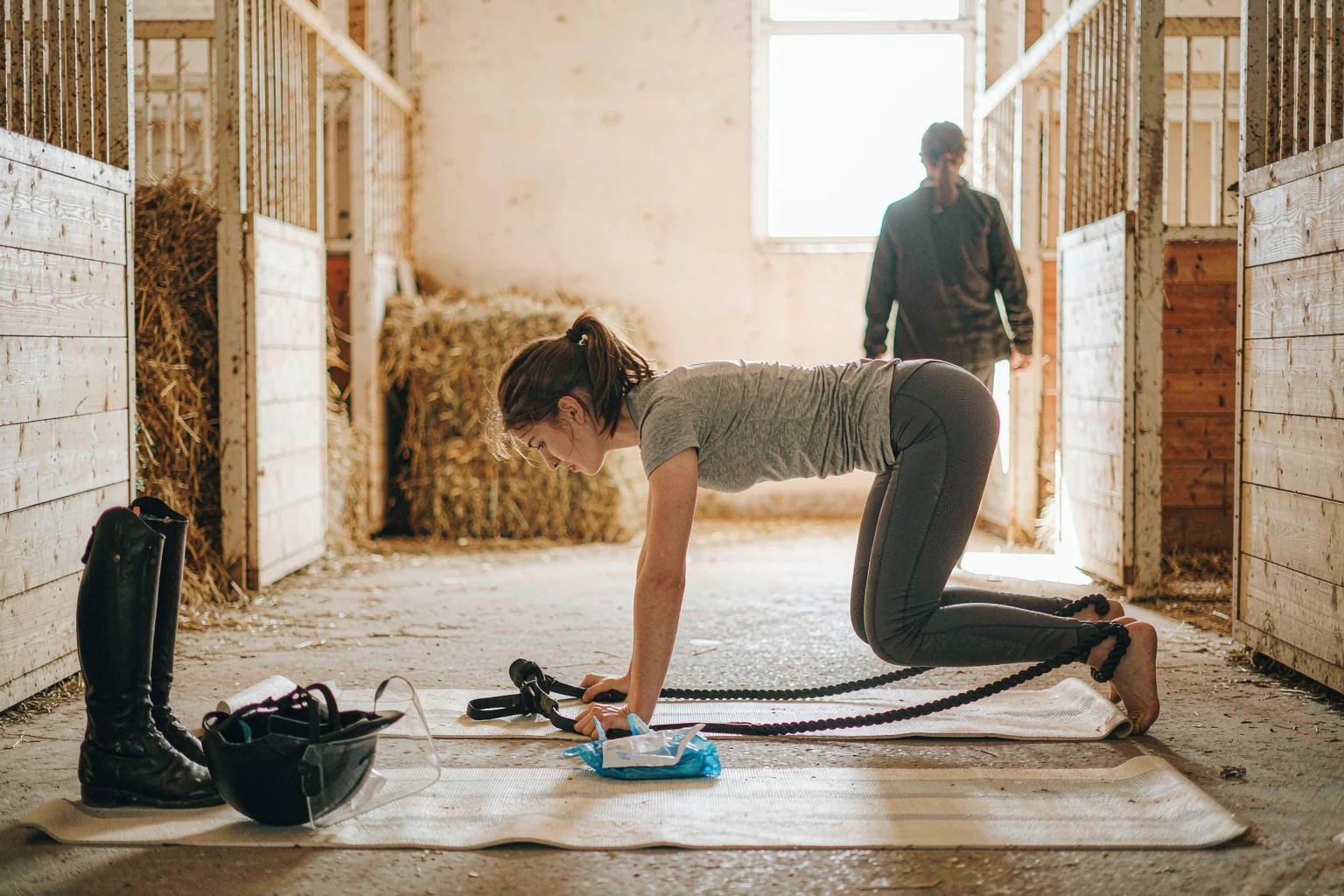
Riding will not make you fit for riding. That is the uncomfortable conclusion of a small but consistent body of research: a 2016 study found a 20-minute session of walk, trot and canter imposed only light to moderate stress on the aerobic system, and a 2023 review noted that few riders cross-train at any level. For leisure riders, that review warns, riding “may place expectations on their bodies that they lack sufficient conditioning to tolerate.” What transfers off the horse is specific: trunk endurance, hip mobility, single-leg balance, a modest aerobic base and quiet grip. Here is the evidence, and a three-session week built on it.
- More saddle time is not a fitness plan. A mixed-gait session stays below the anaerobic threshold except in canter
- Five qualities transfer: trunk/core endurance, hip mobility, single-leg balance, aerobic base, and grip endurance
- Asymmetry is the default. All 17 competitive dressage riders in one study sat asymmetrically
- An eight-week rider-specific core program evened saddle pressure and was linked to an 8.4% mean increase in trot stride length
- Low back pain is the most common overuse injury in young equestrian athletes; almost half of one sample reported an episode in 12 months
- Start with 2–3 short sessions a week; see a physio for persistent one-sided pain or a saddle that always slips
What transfers
Asymmetry & injury
Why riding more fails
A 3-session week
Mistakes to skip
When to see a physio
FAQ
A 2023 Nutrients review calls equestrian sport “under-researched within the sport science literature.” With no mandated fitness benchmark for recreational riders, the program below borrows from rider physiology studies, small symmetry trials and equestrian physiotherapy practice.
What Actually Transfers to the Saddle
Riding is a postural skill first. Electromyography cited in the 2023 review shows elite riders contract musculature independently and contralaterally — holding one part of the trunk steady while another adjusts — rather than simply being stronger. Terada and colleagues found experienced riders hold a near-vertical trunk (about 4° off vertical) through sustained tonic contraction of the abdominals and erector spinae for stabilization, not power. The review is explicit that elite riders are not necessarily stronger than other athletes, while warning that “this is not a rationale to deprioritise strength training.”
| Quality | What it does in the saddle | Train it with |
|---|---|---|
| Trunk & core endurance | Keeps the torso quiet and the seat bones evenly loaded | Dead bugs, side planks, Pallof presses, bird dogs |
| Hip mobility & abductor strength | Lets the leg hang long without the pelvis collapsing; tight hip flexors drive back pain | 90/90 rotations, hip-flexor stretches, single-leg deadlifts, clamshells |
| Balance & proprioception | Recovers a stumble without grabbing the reins | Single-leg stands (eyes closed), slow split squats |
| Aerobic base | Delays late-ride fatigue; a jumping course reached ~75% VO2max in one study | Zone-2 walking, cycling or swimming, 30–60 min |
| Grip & forearm endurance | Holds steady rein contact; linked to rein tension and postural control | Farmer’s carries, dead hangs, towel wringing |
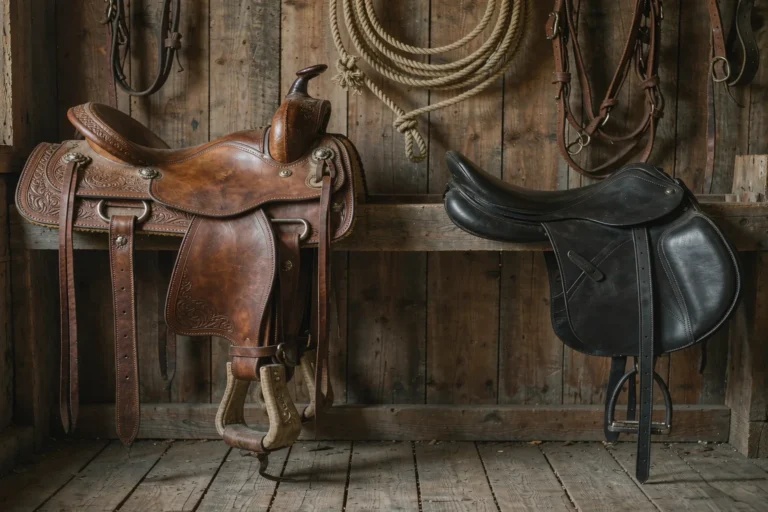
Grip is the most neglected: fatigued forearms produce uneven contact, and some reviews report up to a 40% left–right difference in rein pressure. Hip mobility matters because the saddle holds the legs abducted for long stretches; tight hip flexors tilt the pelvis and tip the rider onto the fork of the saddle. A Western saddle changes the hip angle, but a stiff hip is a crooked seat in either.
Asymmetry and Injury: What the Research Shows
Riders are rarely straight. Symes and Ellis (2009) assessed 17 competitive dressage riders and found all rode asymmetrically, with the thoracic girdle rotated left; they suggested core stability work such as Pilates may reduce it. Byström’s sit-trot kinematics agreed, and Gunst (2019) measured saddle-pressure about 5% higher on the left. A 2020 paper links asymmetric trunk rotation to uneven back-muscle activation and notes repeated asymmetric forces contribute to back and limb pain in the horse too.
The intervention evidence is small but consistent. Hampson and Randle’s eight-week unmounted core program significantly reduced left–right saddle-pressure difference and produced an 8.4% mean increase in trot stride length. A related University of Edinburgh protocol put ten dressage riders through three 20-minute core sessions a week for eight weeks and reported more even seat-bone pressure and close to a 10% stride-length increase. Nevison and Timmis (2013) found physiotherapy to the pelvis and hips improved riders’ postural stability in the saddle.
On injury, low back pain is the most common overuse musculoskeletal injury in child equestrian athletes: in the 2020 sample almost half reported an episode in the previous 12 months, with higher body fat and low trunk lateral flexor endurance as predictors. A Hartpury University study using the Functional Movement Screen found every novice and half of the advanced show jumping riders scored 14 or lower, concluding novices were roughly twice as likely to be at increased injury risk.
Why More Saddle Time Is Not a Fitness Plan
A 2016 European Journal of Applied Physiology study measured 19 competitive riders through a 20-minute walk–trot–canter session and concluded riding “imposes only light to moderate stress on the aerobic and anaerobic energy systems.” Oxygen uptake and CO2 production stayed below the anaerobic threshold; only heart rate approached it, and only in canter (about 158 bpm). A 2018 study of trainee jockeys put walking at 2.4 METs, trotting at 6.2 and cantering at 7.7, and recommended “alternate modes of exercise” to meet racing’s demands.
Riding is also intermittent and isometric: the 2023 review notes heart rate often exceeds what oxygen demand predicts, because repeated isometric contraction drives blood pressure up out of proportion to VO2. That is a real signal, not an aerobic training effect. Devienne and Guezennec (2000) did find a jumping course pushed recreational riders to about 75% of VO2max at ~176 bpm, calling aerobic capacity “a factor determining riding performance” while recommending “additional physical training” to build it. Hard efforts in the saddle are short, sporadic, and load the same patterns making you crooked. Adult beginners often assume the lesson is the conditioning; our guide to starting riding as an adult covers what the first months demand.
A Three-Session Week
The studies converge on a modest, repeatable dose. The 2020 Children paper cites pediatric conditioning evidence of roughly 180 minutes a week of moderate aerobic work across three 60-minute sessions, an eight-week strength program of three days a week (eight exercises, three sets, 3–15 reps, 90–120 s rest), and trunk endurance trained twice a week for ten weeks with a simple floor protocol. The Edinburgh protocol was three 20-minute sessions a week for eight weeks. None is a prescription for adults, but the shape is worth copying: short, frequent, mostly bodyweight, with measurable holds.
| Session | Focus | Example prescription |
|---|---|---|
| A — Core 25–30 min |
Trunk endurance, even seat bones | Dead bug 3×8/side · Side plank 3×30–45 s/side · Pallof press 3×10/side · Bird dog 3×10/side |
| B — Hips & balance 30–40 min |
Hip mobility, abductor strength, single-leg control | 90/90 rotations 2×30 s/side · Hip-flexor stretch 2×30 s/side · Single-leg deadlift 3×8/side · Step-up 3×10/side · Clamshell 3×12/side · Eyes-closed single-leg stand 3×30 s/side |
| C — Aerobic & grip 30–60 min |
Moderate aerobic capacity, forearm endurance | Zone-2 walk, cycle or swim 30–45 min · Farmer’s carry 3×30–40 m · Dead hang 3×20–30 s |
Two sessions a week is a legitimate start; the trunk-endurance evidence used twice-weekly training. Three lets you separate core, hips and aerobic work. Treat the holds as skill practice: slow, level, stopped the moment your pelvis tilts. If you already ride four or more days, keep this light — it is a supplement, not a second job.
Build the Base Off the Horse
- Balance pad — Single-leg work needs an unstable surfaceCheck Price
- Resistance band set — Hip mobility and clamshells at homeCheck Price
- Foam roller — Release tight hips after a long rideCheck Price
Five Mistakes Riders Make
- Treating riding as cardio. The 2016 and 2018 studies call the aerobic stimulus light to moderate and recommend other exercise
- Training “core” as sit-ups. The useful quality is anti-rotation and anti-extension endurance, not repeated spinal flexion
- Chasing symmetry with more riding. Rehearsing one pattern harder does not create a new one
- Going too heavy, too soon. Loaded bilateral lifts do little for single-leg reactive control, and a strained back costs saddle time
- Ignoring grip and hips. Forearm fatigue means uneven contact; tight hip flexors tip the pelvis
And expect the change in weeks, not days: every intervention cited here ran eight to ten weeks. Judge the program at eight, ideally against a video of your seat from behind.
When to See a Physio
Off-horse fitness addresses the general pattern; a physio addresses the specific one. Functional movement screening is increasingly used in equestrian populations to catch mobility, stability and coordination deficits early, and sports-medicine programs argue for integrated care across coaches, physicians, physical therapists and strength trainers. A small 2013 study found targeted physiotherapy to the pelvis and hips improved postural stability in the saddle — not something you can reliably self-diagnose.
Book an assessment, ideally with a rider-focused physio, if any of these persist: low back or hip pain lasting more than a week or returning every ride; a saddle that always slips one way or a stirrup that always feels longer; one seat bone carrying more weight; numbness or pain radiating into a leg; a marked side-to-side difference on a trunk hold (the 2020 study flagged a dominant/non-dominant ratio outside 0.95–1.05); or a return to riding after a fall or concussion.
Ohio State University Extension puts riding at about 3.7 injuries per 1,000 hours — lower than football or basketball but often severe, with roughly 10–30% of horse-related injuries involving the head. No off-horse program replaces a certified helmet.
Quick Answers
How many sessions do I need? Two is enough to start; three lets you separate core, hips and aerobic work. Every study cited used two or three a week for eight to ten weeks.
Will Pilates fix a crooked seat? It is the most-cited suggestion in the symmetry literature, and the interventions that worked all trained trunk stability. Persistent one-sided pain still needs an assessment.
Do I need to lift heavy? No. Elite riders are not necessarily stronger, though that is no reason to skip strength training. Moderate resistance, single-leg work and long holds suffice.
Can I just ride more instead? No — that is the one option the physiology rules out.
Sources
Physiology: Best et al., “The Physiological Requirements of and Nutritional Recommendations for Equestrian Riders,” Nutrients 15(23), 4977 (2023); “Cardio-metabolic responses during horse riding at three different speeds,” Eur J Appl Physiol (2016); Kiely et al., “Physiological demands of daily riding gaits in jockeys” (2018); Devienne & Guezennec, “Energy expenditure of horse riding” (2000). Symmetry and injury: “Trunk Lateral Flexor Endurance and Body Fat,” Children 7(10), 172 (2020); The Riders Physio, “Physical Pre-Requisites to Ride at Your Best: Part B” (Symes & Ellis 2009; Hampson & Randle 2015; Terada; Byström; Nevison & Timmis 2013; Gunst 2019); Equestrian Life, “Fit to Ride”; Hartpury University, FMS scores in novice and advanced show jumping riders; ReachMD, functional movement analysis in young equestrian athletes; Ohio State University Extension, “Equestrian Injury Statistics”.
Guides
Gear & Reviews
Popular Reads
Keep reading: How to start riding as an adult · English vs. Western: which to choose · Your first tall boots: what to spend