Trail Riding Etiquette and the Safety Kit That Fits in a Saddlebag
Trail Riding Etiquette and the Safety Kit That Fits in a Saddlebag
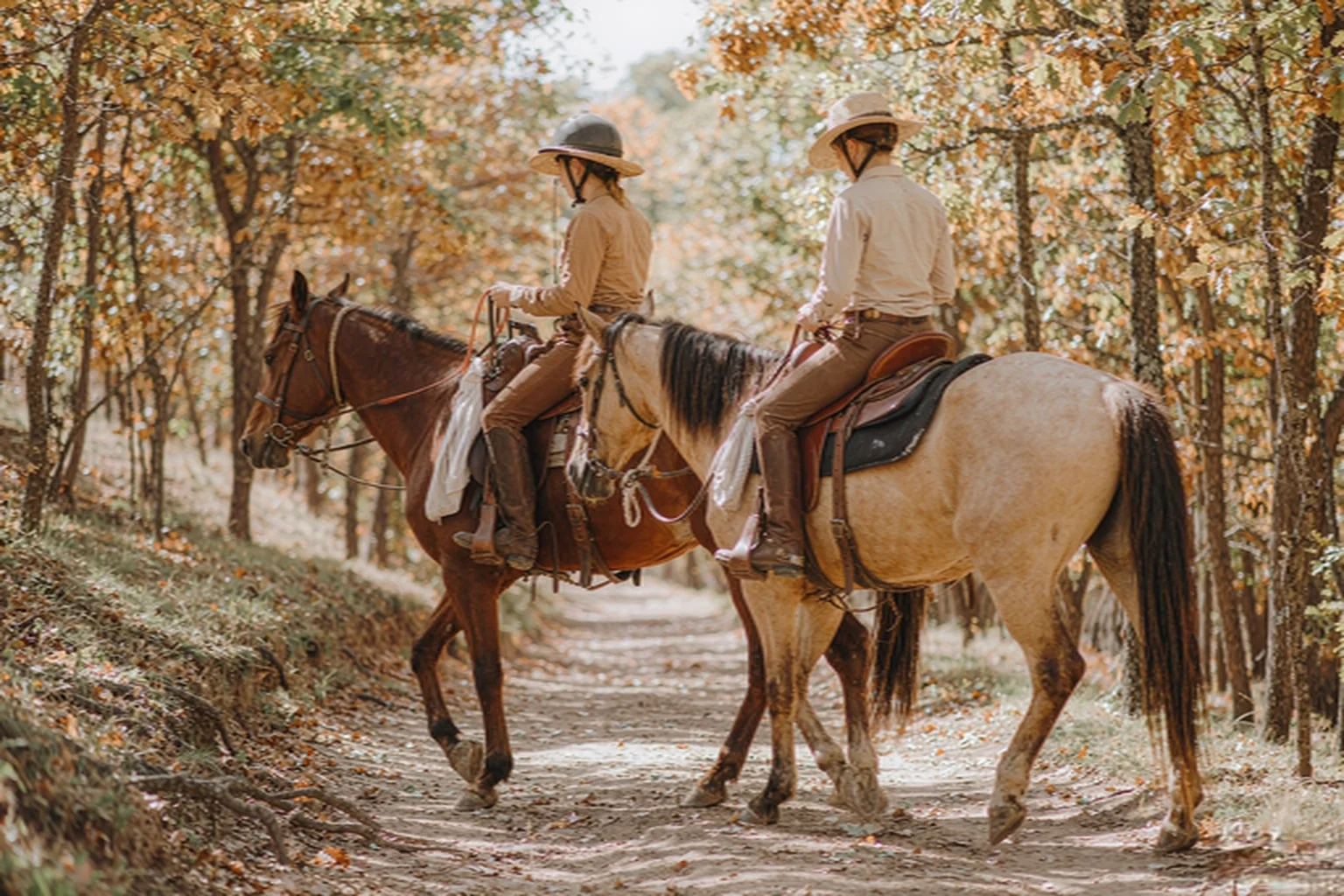
On a shared trail the horse is the biggest, most easily startled thing on the path — and, almost everywhere, the one with priority. Virginia State Parks puts it plainly: “Horses always have the right of way,” with a hierarchy of Horses > pedestrians > bikes/e-bikes. But priority is not safety. The British Horse Society says pass people and vehicles at a walk, allow plenty of space, and be ready to dismount or wait. What keeps a ride uneventful is simple: how you open a gate, the gap between horses, the note at the barn, and your saddlebag. Here are the rules, exceptions, and what to leave at home.
- On most US shared trails horses > hikers > bikes — but pass at a walk and be ready to dismount
- Leave every gate as you find it. The group waits until it is closed and the rider remounted
- One horse length between horses; ride at the pace of the least experienced; mark kickers with a red or orange tail ribbon
- File a ride plan: route, return time, who is riding, which horses, a contact number
- Carry two first-aid kits, a charged phone on your person, a hoof pick, halter and lead, a knife, and water
- Avoid afternoon high-country lightning, ride within daylight, and wear high-viz
Right of way
Gate etiquette
Groups & spacing
People & animals
Tell the barn
The safety kit
Weather & daylight
What to skip
Rules vary by land manager, so check the agency or park first. What follows is the common ground across state parks, the US Forest Service, the BHS and Back Country Horsemen of America.
Who Yields: Right of Way and Passing
Virginia State Parks sets the hierarchy as Horses > pedestrians > bikes/e-bikes; the USDA Forest Service says “Horses have priority, followed by hikers, and then bikers”; California State Parks puts it as “Hikers have the right of way to bikers, but must yield to equestrians.” Stay right, pass left, announce the pass with a clear “On your left!”, and yield to uphill traffic — find a wide spot and let an uphill horse through.
| You meet | Priority | Your move |
|---|---|---|
| Hikers or runners | The horse | Slow to a walk, greet them, hold your line, thank them |
| Cyclists or e-bikes | The horse | Ask them to stop and speak; say when it is safe to pass; ask them to dismount if your horse is unsure |
| Another rider going uphill | The uphill horse | Find a wide area and let them through |
| A dog with its handler | The horse | Ask for the dog to be held close and still |
California State Parks adds the caveat: “Even though you have the right of way on the trail, be aware that bikers and hikers can act unpredictably, so make sure to always have control of the horse.”
Gate Etiquette
The rule is short: leave all gates as you find them — open or shut. The BHS and Blackdown Hills say so: a gate left open can put stock on a road; one left shut can block a farmer’s access. Never jump a gate; lead the horse through.
The group procedure matters as much as the gate. Back Country Horsemen of Missoula’s policy is explicit: “When it is necessary to dismount, as when opening a gate, all riders will wait until the person who dismounted has closed the gate and is mounted again.” One rider dismounts, leads the horse clear, latches the gate and remounts before anyone moves; everyone else holds well back, since a queue bunched at a gate is where kicks happen. Check traffic first if it opens onto a road, and thank drivers who slow down.
Groups, Spacing and Pace
The standard gap is one horse length. Horse Journals gives the reason: “keep one horse length between horses so that if a horse kicks, the rider behind won’t be struck by accident.” Widen it on steep ground. BCH Missoula adds: “Maintain adequate distance from the livestock in front of you while on the trail,” and asks that “horses known to be kickers should be marked with an orange or red flag in the tail.”
Appoint a leader and a sweep. BCH Missoula says “a trail leader will be appointed for each ride,” that riders stay with the leader, and that “A BCH day ride is not the place for a horse race.” Ride at the pace of your least capable companion, call out low branches and other hazards, and announce pace changes. Keep the group small: BCHA recommends “small groups with the minimum number of animals necessary” and riding “single file in the middle of the trail, especially when wet or muddy.”
Meeting Hikers, Dogs, Vehicles and Livestock
Hikers. BHS says “always pass other people and vehicles at a walk, allow plenty of space, and be prepared to dismount or wait for others to pass if required.” Speak in a relaxed tone — a horse cannot see directly behind, and a voice tells it you are a person. Let people take the downhill side; the Forest Service notes horses read an uphill figure as a threat and bolt uphill when startled.
Dogs. Washington Trails Association guidance says “trail users with dogs should yield to all other trail users” and dogs should be leashed. Ask the handler to stand still and hold the dog close; never assume a “friendly” dog is safe. Some organized rides exclude dogs entirely.
Vehicles. Pass at a walk, give room, and wear high-viz: BHS says “BE SAFE AND BE SEEN… WEAR HIGH-VIZ,” and Blackdown Hills notes “BHS advises that you wear a fluorescent vest while riding on roads.” Keep the horse’s head toward traffic and avoid roads in low light, where headlights confuse horses.
Livestock. BHS: “Take particular care through livestock, especially fields with cows and calves, or horses. Use an alternative route if possible or keep a safe distance and pass at a walk.” Never get between a cow and her calf; watch for bulls; ride slowly past all stock. Give wildlife an escape route; deer and predators are most active at dusk.
Tell the Barn Where You Are Going
BCHA’s “Trail Rider Checklist” opens with “Let a responsible person know your trip plans, i.e. places and dates,” and says to contact the trail manager for current conditions. Horse Journals is more specific: “Tell someone at home where you are going, what trail(s) you are taking, and what time you plan to be back. Take your cell phone and make sure it is fully charged.” Ride with a friend where you can.
A workable plan lists the route, expected return time, who is riding, which horses, and a phone number. Agree on what counts as “overdue,” and check in when you are back. Keep your phone, ID, medical information and emergency contact in a zipped pocket on your person — Horse Journals notes they “are no help to you if they are packed in the saddle bag and you become separated from your horse.” If you ride from a livery barn, ask how rides are logged out and back; worth checking when choosing a riding barn.
The Kit That Actually Gets Carried
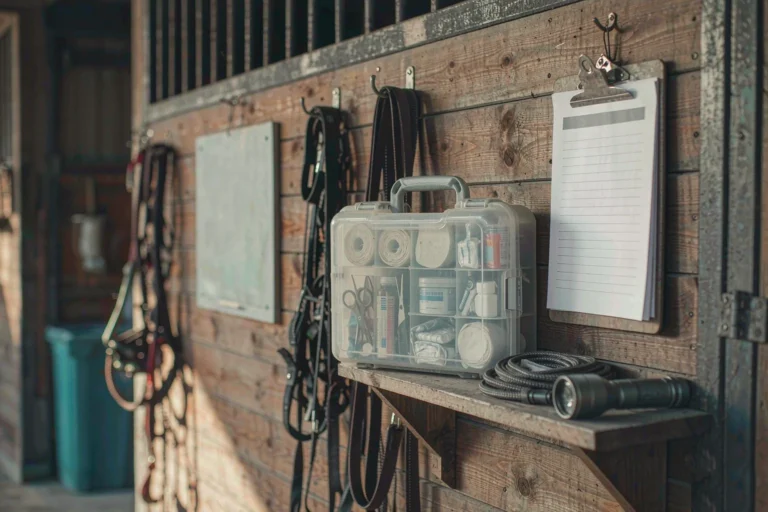
- Equestrian first-aid kit — Horse and rider in one compact caseCheck Price
- LED clip-on light — Low-light gate checks on the trailCheck Price
- Hoof pick with brush — Mud and stones before you ride homeCheck Price
A Compact Trail Safety Kit
Back Country Horsemen of Montana’s guidebook defines wilderness medicine as “dealing with medical problems two miles or more from the nearest trailhead,” and makes the key point: “At least one person on the ride needs first aid supplies and the knowledge of how to use them.” Pack two small kits — one for you, one for the horse — plus a shared emergency pouch.
| Category | Pack | Why |
|---|---|---|
| Rider first aid | Gloves, 4×4 gauze, 3-inch elastic wrap, adhesive and duct tape, blister kit, triangular sling, reflective blanket, pocket manual, personal medications | Clean water and soap suffice; the BCH guide says there is “no need to carry liquid such as disinfectants or alcohol pads” |
| Horse first aid | Hoof pick, vet wrap, gauze, clean water, antiseptic, spare shoe or hoof boot, leather punch | BCHA lists an “equine first aid kit” with a “horseshoe and nails or replacement boot” and hoof pick |
| Emergency & comms | Charged phone on your person, ID and emergency contacts on your body, whistle, headlamp, space blanket, satellite messenger for remote country | BCHA: “Explore emergency communication options – cell service, satellite phone, two-way texter”; electronics do not always work |
| Tack repair & tools | Halter under the bridle plus a 10-ft lead rope, multipurpose knife, spare reins or leather thongs, Chicago screws, baling twine | BCHA lists a “repair kit with extra leather thongs, Chicago screws”; Horse Journals advises a halter under the bridle |
| Food, water & weather | Canteen, high-energy snack, electrolytes, rain shell, sun lotion, insect repellent, high-viz vest | BCHA: “Water, bucket, sponge, sweat scraper”, “Rain slicker”, “Canteen”, “Sun lotion” |
Keep the kit small enough to carry, and check it twice a season for expired medications and dead batteries.
Weather and Daylight Planning
Start with the forecast and the ground. California State Parks advises checking closures and trail conditions after rain; BCHA says to contact the trail manager for “current trail conditions and any restrictions” and plan for “excessive heat or cold, strong winds, unpredicted snow, flash floods.” BHS warns “if you are leaving deep hoofprints, you are not riding responsibly.” Be ready to alter the route if conditions are unsuitable.
Lightning: BCHA says “select trails that avoid high mountain areas during afternoon lightning storm seasons” — be off exposed ridges by early afternoon. In heat, carry extra water and keep the horse hydrated. For daylight, Blackdown Hills recommends a map and compass, food, drink and waterproofs; BCHA adds “download maps offline.” Horse Journals suggests walking the last mile home, and for low light: known trails, a walk, a headlamp, reflective gear — “wildlife is often on the move during the evening or at night.”
What to Skip
- Riding alone in remote country. Horse Journals: “For safety’s sake, ride with a friend.” If solo, the ride plan is non-negotiable
- Headphones. You need to hear hoofbeats, bikes, branches and the rider behind
- A green horse on a busy multi-use trail. BCHA says “take only animals that are fit, calm, and experienced”; inexperienced horses should follow trail-wise ones
- Racing or any pace faster than conditions allow. BCH Missoula: “A BCH day ride is not the place for a horse race”
- Pushing through mud and soft ground. It damages the trail and the access that depends on it
- Assuming priority means pushing through. If passing is awkward, stop, dismount, or wait
- “Just one more mile” at dusk. Turn back while you still have light
- Litter and manure on shared paths. BHS asks riders to move the horse off the path before it dungs; BCHA says “scatter manure at all rest stops”
Sources
Right of way: Virginia DCR, trail etiquette; California State Parks, “Trail Etiquette & Safety”; USDA Forest Service, “Share the Trail”; Washington Trails Association, “Sharing the Trail”. Gates & livestock: British Horse Society, “Horse Sense” (PDF); Blackdown Hills National Landscape, horse riding. Planning & first aid: Back Country Horsemen of America, “The Trail Rider Checklist”; BCHA, “Light on the Land” (PDF, 2025); Back Country Horsemen of Missoula, ride safety policy; Back Country Horsemen of Montana, guidebook (PDF); Horse Journals, “Head First”.
Guides
Gear & Reviews
Popular Reads
Keep reading: 12 red flags when choosing a barn · What to wear to your first lesson · Equestrian disciplines explained