Rider Safety Gear and Insurance: What the Standards Actually Cover
Rider Safety Gear and Insurance: What the Standards Actually Cover
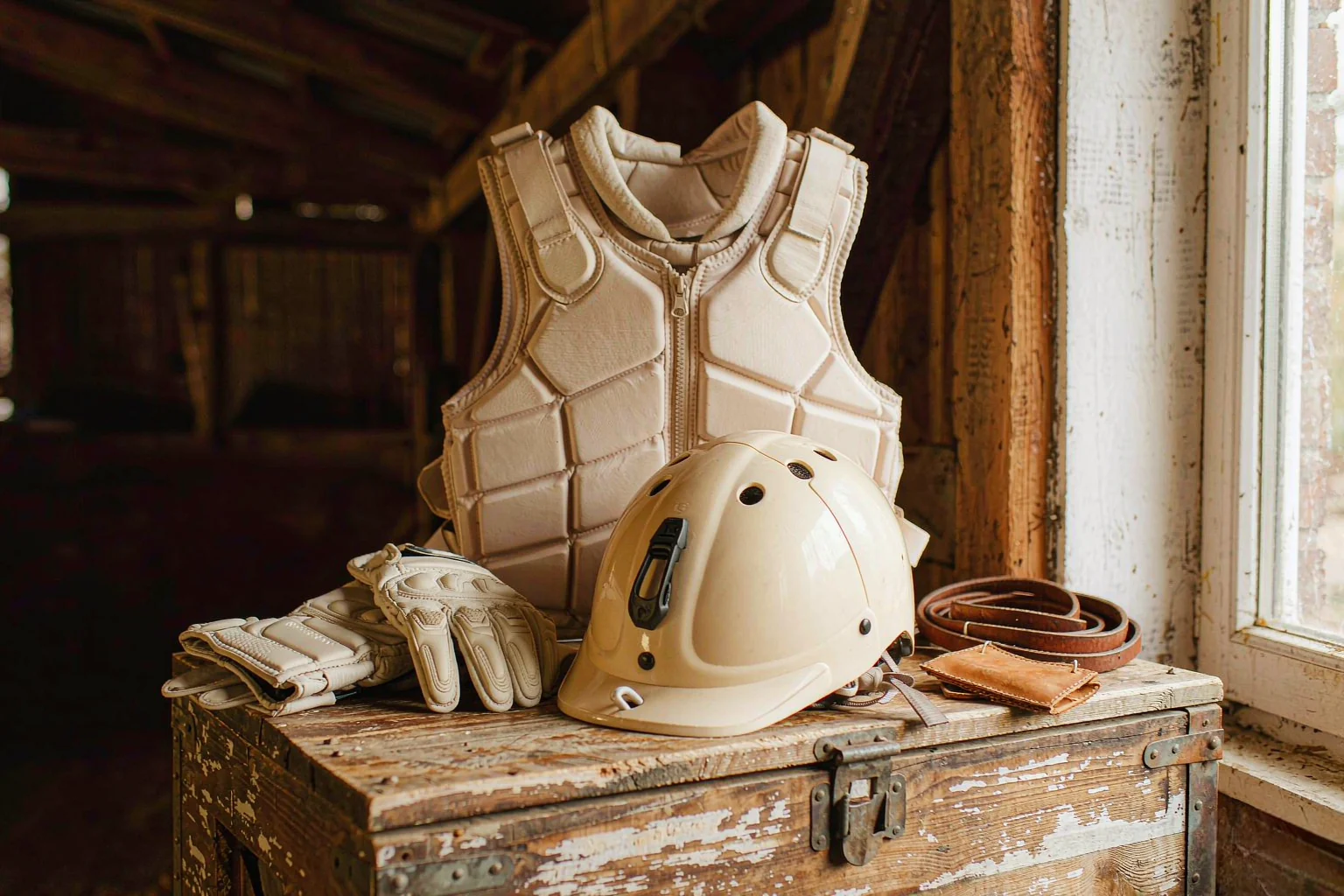
A riding helmet is the one piece of kit where the label matters more than the price tag. In the US that label is ASTM F1163 with an SEI mark — and a helmet that has taken a fall is finished even when it looks perfect. Body protectors, air vests and insurance each cover a different slice of risk, and none covers all of it. Here is what the standards actually certify and what to ask before you pay a premium.
- ASTM writes the test; SEI certifies the helmet. Look for both: ASTM F1163 (current edition F1163-23) with the SEI mark inside
- F1163-23 replaced F1163-15 and added a crush test; SEI moved to it in 2025
- Replace a helmet after any fall where your head hits something, visible damage or not, and on the maker’s schedule (commonly around five years). Never buy used
- US Equestrian’s GR801 requires ASTM/SEI headgear at licensed hunter/jumper shows — and states that no helmet can protect against all foreseeable injuries
- A body protector to ASTM F1937 or EN 13158 / BETA Level 3 does not protect the spine or against crushing. The BHS says an air jacket worn alone offers little protection
- Personal accident covers you; liability covers other people. Homeowners and renters policies generally exclude horses
Helmet standards
Fit & replacement
Vests & air bags
Boots & stirrups
What insurance covers
Questions to ask
What to skip
FAQ
Ask what each object was tested to survive, not which one the barn says to buy. A certification is a narrow laboratory claim, not a promise about a living animal — and with insurance, the costly mistake is assuming a policy you already own covers what just happened.
What a Helmet Standard Actually Certifies
The US benchmark is ASTM F1163, the Standard Specification for Protective Headgear Used in Horse Sports and Horseback Riding. Two bodies split the job: ASTM International writes the requirements and test methods, while the Safety Equipment Institute (SEI) independently tests models, audits production and lists what it certifies. “ASTM/SEI certified” is the phrase to look for; either half alone means less.
The current edition is F1163-23, superseding F1163-15; SEI moved to it in 2025, adding a crush test. A helmet is conditioned in ambient, cold, hot and wet states, then impacted on a flat anvil and a shaped “equestrian hazard” anvil, plus loading and stability tests. That hazard anvil is what separates a riding helmet from a bicycle helmet: falls involve edges, hooves and fence rails.
Now the limit. ASTM’s scope says the standard “does not purport to address all of the safety concerns” of its use, and US Equestrian’s GR801 warns that “no helmet can protect against all foreseeable injuries.” Certification is a floor: it confirms a model passed lab tests when new. It does not rank helmets, guarantee your fit, promise survival of a fall, or describe years of sweat and knocks since manufacture.
GR801 requires fastened ASTM/SEI headgear with the SEI tag for anyone mounted at a licensed hunter, jumper or hunter/jumper competition; US Equestrian also accepts PAS 015, VG1, Snell and EN 1384 variants with the right quality marks. Check the current rulebook each season, and see our beginner helmet guide for fit.
Fit, Falls and the Replacement Rule
A certified helmet worn loose is a poor helmet. It should sit level and low on the forehead, stay put when you shake your head with the harness undone, and feel snug without pressure points. Get a professional fitting — fit is the part no lab test can do for you.
Replace the helmet after any fall where your head contacts anything, visible damage or not: the liner crushes as it absorbs energy and the damage is often invisible. That holds for a helmet dropped hard onto concrete too. Makers generally recommend roughly five years, but the interval and manufacture date are printed in the manual or on a label inside the shell — read yours. Two consequences: never buy used, and check the manufacture date on a new one.
Standards First, Features Second
- ASTM/SEI riding helmet — The one piece that is not optionalCheck Price
- Body protector vest — Level 3 coverage for trail and jumpingCheck Price
- Riding gloves — Grip and blisters in cold weatherCheck Price
Body Protectors, Air Vests and the Alphabet Soup
Three international standards cover foam protectors: ASTM F1937 (US), EN 13158 (Europe) and ASTM F2681 (racing). None turns a vest into a shield.
| Label | Who stands behind it | What the test measures | What it does NOT claim |
|---|---|---|---|
| ASTM F1163 / SEI (helmet) | ASTM + SEI | Impact on flat and hazard anvils, retention, stability, cold/heat/water conditioning; F1163-23 adds crush | Fit, all injuries, protection after a fall |
| ASTM F1937 / SEI (protector) | ASTM + SEI | Shock attenuation, penetration, impact sites, padding separation, closure — in four conditioning states | Spinal protection or crushing injuries |
| EN 13158:2018 / BETA Level 3 | European standard; BETA labels | Coverage area, impact on flat ground and fence rails, attachment security; annual re-testing | Severe torsion, flexion or extension |
| Air jacket (SATRA M38) | Test-house specification | Ergonomics, inflation speed and pressure, activation force, lanyard strength | Standalone protection — BHS advises a Level 3 protector underneath |
ASTM F1937, active version F1937-04(2023)e1, tests shock attenuation, penetration, impact sites, padding separation and closure in four conditioning states. EN 13158 instead controls the area covered, tests impact on flat ground and fence rails, and measures attachment security; BETA re-tests approved models annually.
BETA levels mislead shoppers. Level 1 (green) is for racing; Level 2 (orange) is low-risk only and excludes roads, jumping, young horses and inexperienced riders; Level 3 (blue) is for normal riding, competition and working with horses. The BHS recommends Level 3 because it “will meet the requirements for any equestrian discipline,” while US Equestrian requires ASTM F1937 or SEI protection for cross-country.
The ceiling: protectors shield the abdomen, organs and thorax but do not offer direct spinal protection, do not protect against crushing, and do not protect against severe torsion, flexion or extension. Air jackets inflate on separation from the saddle, yet the BHS says they “do not currently meet any recognised safety standards” and “when worn alone, they offer little protection to the rider.” Wear one over a Level 3 protector.
Footwear and Stirrup Safety
Footwear addresses one accident: the foot sliding through the stirrup and the rider being dragged. Boots need a smooth sole and a defined heel, with no chunky tread that can catch. Paddock boots with half chaps, tall boots and Western boots work; trainers, sandals and heel-less fashion boots do not. See our what-to-wear guide.
A 2025 GR801 change, effective 1 April 2025, banned hooks and upward projections on saddles, including open-bar stirrups, because stretchy apparel can snag. Breakaway stirrups exist, but none substitutes for a heel that belongs in the iron.
What Rider Insurance Does — and Does Not — Cover
Gear manages the physics of a fall; insurance manages the bill. The two products riders confuse most point in opposite directions.
| Cover | Who it pays | Typically includes | Typically does NOT include |
|---|---|---|---|
| Personal accident | You, the injured rider | Medical costs, rehab, weekly or lump-sum benefits for lost income, disability or death | Harm you cause others; your horse’s vet bills |
| Equine / personal liability | A third party you are liable to | Injury or property damage your horse causes others, plus legal defence costs | Your own injuries; the horse’s value |
| Mortality / major medical / loss of use | You, as the horse’s owner | The horse’s agreed value, or vet and surgical costs | Anything for you as a rider; a horse you do not own |
| Homeowners / renters | Third parties, narrow terms | Sometimes on-premises animal liability | Horses as livestock, off-premises incidents, business use, “care, custody and control” of a leased horse |
Personal accident is the rider’s own cover: medical costs, rehab, weekly income benefits and lump sums for disability or death; some “all of life” policies cover accidents away from horses. Liability is the opposite — it responds when you are found responsible for someone else’s injury or property damage, paying compensation and defence costs even when you win. Mortality, major medical and loss of use cover the animal, not you.
The gap: homeowners and renters policies generally exclude horses as livestock. Carve-outs include off-premises incidents, any paid activity, and “care, custody and control” of a horse you manage but do not own — which matters if you lease; see our lease-versus-buy breakdown. Equine Activity Liability Acts in most states limit sponsors’ liability for inherent risks but do not cover negligence and are not a policy; the Insurance Information Institute makes the same point from the property side.
Questions to Ask Before You Buy a Policy
Sold in generalities, paid on definitions. Get these answers in writing:
- Is riding and handling named as a covered activity? A “hazardous sports” exclusion is not cover
- Does cover follow me off the premises? Confirm trail rides, shows, clinics and other barns
- Am I covered for a horse I lease or borrow? Ask about “care, custody and control” and whose policy is primary
- What are the medical limits, and is this excess to my health insurance? Check deductibles, rehab and dental work
- Is there a weekly income benefit, and what triggers it?
- Does liability include legal defence and adequate limits?
- Does my homeowners, renters or umbrella policy exclude horses?
- What is the claim notice period? Late notification is a common reason for refusal
Two questions help most: “If I am injured and cannot work for three months, which policy pays?” and “If my horse injures someone at a show, which policy defends me?”
What to Skip
- A used helmet. You cannot know its fall history or age, and the damage that matters is inside the liner
- A helmet certified only to a superseded edition. F1163-15 was replaced by F1163-23; check the tag against SEI’s certified list
- An uncertified “padded vest” or a back protector sold as a body protector. A fashion gilet covers fewer scenarios
- An air vest worn alone. Wear it over a fitted Level 3 protector and follow the lanyard instructions
- Assuming your existing policies cover riding. Homeowners, renters and generic accident cover are the usual blind spots
- Horse mortality cover when you do not own a horse. A weekly lesson rider needs personal accident cover first
Quick Answers
Do I have to wear a certified helmet? At US Equestrian licensed hunter, jumper and hunter/jumper competitions, yes, while mounted. At home no official checks — which is why the label matters most there, since most falls happen at home.
Can I use a bike or ski helmet? No. Equestrian headgear is tested against a hazard anvil under different impact and retention requirements.
Is MIPS worth it? A low-friction layer for rotational forces — a technology, not a certification. It sits on top of ASTM/SEI, never instead.
Sources
Standards and scope: ASTM F1163, Standard Specification for Protective Headgear Used in Horse Sports and Horseback Riding (active edition F1163-23); ASTM F1937, Standard Specification for Body Protectors Used in Horse Sports and Horseback Riding (F1937-04(2023)e1); Safety Equipment Institute, certification programs; ASTM International, “Certifying the Standard” (SEI equestrian helmet program). Competition rules: US Equestrian, GR801 rule change (effective 1 April 2025) and US Equestrian, Chapter 8, Subchapter 8-A (GR801). Body protector levels, limits and air-jacket guidance: British Horse Society, Body protectors. Edition transition cross-checked against Equestrian Sports New Zealand, Changes to Helmet Tagging Policy (December 2025). Insurance framing: Insurance Information Institute, “Rampaging animals and farm liability insurance”.
Guides
Gear & Reviews
Popular Reads
Keep reading: Helmets: certification beats brand · Is horse insurance worth it? · What to wear to your first lesson