Your First Horse Show: What It Actually Costs (2026 Prize Lists)
Your First Horse Show: What It Actually Costs (2026 Prize Lists)
A first horse show costs about $296 at a schooling show and $435 at a rated one in 2026 — before memberships, braiding, hauling or your trainer’s day rate. Here is the entire bill from four real prize lists, and an eight-week plan so nothing on show morning is a surprise.
- A schooling show runs $300–$500 all-in; a rated show runs $600–$1,200 before your trainer’s bill
- Class fees are the smallest line: office fees, stalls and per-entry federation surcharges add $150–$300
- The trainer’s day rate ($75–$100) plus day care ($55–$100 a day) is the single biggest cost at most shows
- USEF membership is $100 a year; the one-show pass is $85 — the break-even is two rated shows
- Enter 8 weeks out and mind the closing date: late entries cost $25–$60
Schooling or rated
Real 2026 fees
Hidden line items
Memberships
Trainer’s bill
8-week plan
Packing list
What to skip
Almost every first-timer budgets for class fees and then gets caught by four other lines: the office or facility fee, the stall, the federation surcharge that is charged per entry, and the trainer’s day rate. On a two-day rated show those four lines usually cost more than the classes themselves. Once you see them laid out, the total stops being scary and starts being plannable.
Schooling Show or Rated Show?
This is the only decision that matters at the start, and it decides your budget, your paperwork and your outfit.
| Schooling show | Rated (licensed) show | |
|---|---|---|
| Who runs it | A barn or local association | Under US Equestrian rules |
| Memberships needed | None | USEF $100 + USHJA $85 |
| Class fee | $20–$30 | $30–$40, or $80–$120 a section |
| Federation fee per entry | — | $25 USEF + $10 USHJA |
| Stall | $30–$90 | $150–$210 for the show |
| Points toward year-end awards | No | Yes |
| Typical first-timer total | $300–$500 | $600–$1,200 |
Start at a schooling show. Not because it is cheaper — although it is — but because at a rated show the standards for turnout and the pace of the day are set by people who have done this for years. You want your first experience of “waiting at the ingate” to be somewhere forgiving.
What Four 2026 Prize Lists Actually Charge
These are published fees, not estimates. The class fees are the smallest line in every one of them.
| Show | Class fee | Office / admin | Stall | Other mandatory |
|---|---|---|---|---|
| World Equestrian Center summer series, Ohio (schooling) | $25 each | $81 per horse | $90 | $25 late entry |
| Kansas Hunter Jumper Association (schooling) | $20 member / $25 non-member | $25 per horse-rider | $30 per day | Shavings $10 a bag |
| Beverly Equestrian, Virginia (USEF rated) | $30 hunter / $35 equitation / $35 jumper | $10 office fee | Quoted with entry | $35 late paperwork |
| Germantown Charity Horse Show, Tennessee (rated) | $120 a section, or $40 a class | $35 federation fees per entry | $210 | Schooling $30, night watch $20, medic $20 |
A rider entering one four-class section at Germantown pays $435 to the show before membership, hauling or the trainer. The same rider at the Ohio schooling series pays $296 for five classes, admin and a stall. That is the entire gap between the two kinds of show, in two numbers.
The Five Line Items Nobody Quotes You
| Line | 2026 range | What it is |
|---|---|---|
| Office / facility fee | $10–$81 per horse | Show secretary, online entry system, schooling ring, EMT |
| Federation fee per entry | $25 USEF ($15 drugs + $10 federation) + $10 USHJA | Charged every time you enter, not once a year |
| Stall and shavings | $30–$210 plus $10 a bag | Many shows do not allow showing from the trailer |
| Medic and night watch | $20 + $20 | On-site EMT and overnight security, billed per horse |
| Schooling / ticketed warm-up | $10–$30 | Paid practice in the competition ring before your class |
The federation fee is the one that surprises people, because it is per entry rather than per show. Enter six classes at a rated show and you pay it six times.
Memberships: When You Actually Need One
If you are doing one rated show, the arithmetic is not obvious. A USEF competing membership is $100 a year (it rose from $80 on 1 April 2026) and a USHJA active membership is $85. A one-day USEF show pass is $85 — it was $45 until December 2025 — and you can only use it once per competition year.
| Item | 2026 cost | Notes |
|---|---|---|
| USEF competing membership | $100 / yr | Three-year renewal is $285 |
| USEF subscriber (non-competing) | $35 / yr | Access and insurance, no competing |
| USEF show pass | $85, once per year | No points, no year-end awards |
| USHJA active membership | $85 / yr | Required for rated hunter, jumper and equitation |
| Annual horse recording | $115 / yr | Lifetime $500; only if you are earning points on that horse |
Show-Day Kit
- Show shirt with snap collar — The collar is the part judges see firstCheck Price
- Hairnets, pack of 12 — Buy a pack, lose two a showCheck Price
- Braiding kit with yarn and pull-through — Cheaper than paying a braider per dayCheck Price
Your Trainer’s Bill Is the Biggest Number
Prize lists are public. Trainer rate sheets are not, which is why this is the line that blows up first-show budgets. Published 2026 examples:
| Charge | 2026 rate | How it is billed |
|---|---|---|
| Coaching at the show | $75–$100 a day | Per rider, per show day |
| Day care / grooming | $55–$100 a day, or $300 a week all-inclusive | Per horse; entries, braiding and vet billed separately |
| Training ride | $40 a ride | Often needed the day before |
| Hauling | $1.50 a mile, or per trip and split between families | Round trip, plus tolls |
| Braiding | Quoted per horse per day | Independent braider, cash on the day |
Ask three questions before you enter, in this order: what is your day rate, is the horse on day care or full board that weekend, and what do you expect me to pay the braider. Barns answer these without blinking — it is the families who do not ask who get the unpleasant invoice.
An Eight-Week Countdown
| When | What to do |
|---|---|
| 8 weeks out | Pick the show with your trainer and confirm you meet the eligibility for the class (some sections are restricted by age or lifetime wins) |
| 7 weeks out | Confirm the horse: your own, a lease, or a school horse the barn will let you show |
| 6 weeks out | Buy memberships and record the horse if points matter. Do this early — numbers take days to issue |
| 5 weeks out | Check the prize list for the closing date and what documents it wants: negative Coggins, signed waiver, vaccination record |
| 4 weeks out | Ride the test or course in a lesson. Practise the actual transitions, not the general skill |
| 3 weeks out | Sort turnout: coat, shirt, breeches, boots, gloves, hairnet. Try everything on, including with the number pinned |
| 2 weeks out | Enter online. Late entries at some shows cost $25–$60 and paperwork after the closing date costs $35 |
| Week of | Pack the trailer the night before, print the prize list, charge the phone, put cash in the car for the braider |
What to Pack
| Category | Items |
|---|---|
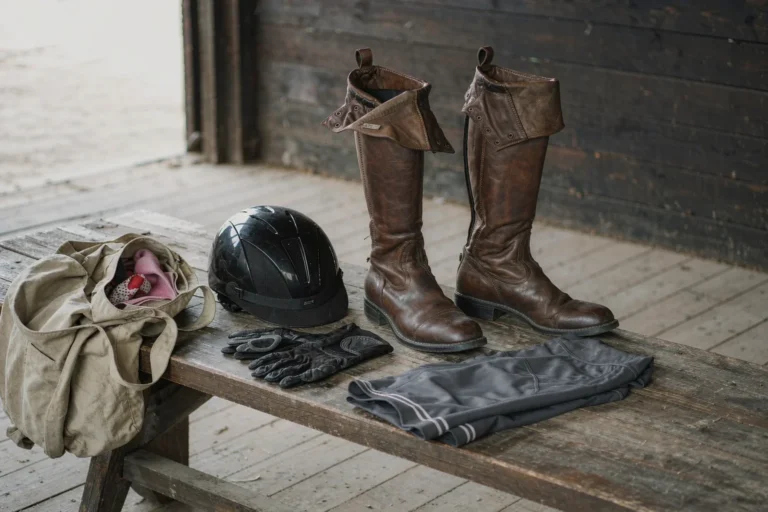
| You | Coat, two shirts, two pairs of breeches, tall boots or gaiters, gloves, hairnet, helmet with the current standard label, belt |
| The horse | Saddle, two pads, bridle and a spare, martingale, crop, lunge line, cooler, bucket, hay net, water from home |
| Grooming | Body brush, curry, hoof pick, baby wipes, show sheen, hoof oil, rag, scissors, plaiting bands, yarn and pull-through |
| Paperwork | Printed prize list, entry confirmation, Coggins, membership cards, back number, trainer’s phone number on paper |
| Survival | Water, food you can eat standing up, sunblock, rain jacket, folding chair, phone battery pack, cash |
The two items people forget most often are water from home — because horses often refuse a strange bucket on the first night — and a second pair of gloves, because the first pair will be wet by 9am.
Five Things to Skip at Show One
- A new saddle. A first show is not the day to change the thing you sit in.
- Professional photos before you have seen the proofs’ price list. They are worth it, but ask first; packages run well past $100.
- Entering more than one section. Two classes is plenty. Three sections means you are tacking up while everyone else is eating lunch.
- Braiding lessons the week of. Practise braids in July for an August show, or pay the braider and watch.
- Any gear you have not ridden in. New boots, new breeches and new gloves all behave differently under pressure.
What “Good” Looks Like at Your First Show
Not a ribbon. The realistic wins are: you got to the ingate on time, you remembered the course, your horse came out of the ring no worse than he went in, and you can name two things you would do differently. Riders who measure show one that way are the ones still competing five years later — and the ones who measure it in ribbons tend to quit after the first bad draw.
Budget $300–$500 for a schooling show and $600–$1,200 for a rated show, add your trainer’s day rate, and put $100 aside for the things you did not plan. That number is honest, and knowing it in advance is most of the reason a first show feels manageable instead of enormous.
Before You Enter
- Number holder or armband — Every show hands you a paper number and no way to attach itCheck Price
- Boot polish kit — Tall boots get scuffed in the truck, not the ringCheck Price
- Garment bag that hangs flat — Keeps the coat unwrinkled in a tack roomCheck Price
Guides
Gear & Reviews
Popular Reads
Keep reading: Horse lease vs. buying: the 2026 math · How to choose a riding barn: 12 red flags · What riding lessons really cost in 2026