Equine Asthma (Heaves): The Barn Is Usually the Problem
He coughs twice at the start of every ride and then it settles, so you forget about it. Six months later he is blowing at the canter and his flank has that telltale dip along the bottom edge. Equine asthma is a disease of the air the horse breathes, and the horse is usually living inside the cause.
Know the red lines
Signs that mean call now, not tomorrow morning
- Breathing hard at rest with flared nostrils and an extended neck — call now
- Mouth breathing, or a horse standing with elbows out and unwilling to move
- Blue-tinged gums or tongue, or collapse
- Fever with a wet cough and nasal discharge — pneumonia, not asthma
- Any horse that has been treated for asthma and is getting worse despite treatment
Print this list. Tape it inside the barn door. Under stress nobody remembers a web page, and the person left holding the horse at 9 pm may not be you.
What is actually happening
Equine asthma is a spectrum. At the mild end — mild to moderate equine asthma, previously called inflammatory airway disease — the horse coughs, has a bit of nasal discharge and performs below its ability. At the severe end, severe equine asthma (the old name was heaves, or recurrent airway obstruction) the horse is in obvious respiratory distress at rest, with a pronounced heave line from the abdominal muscles used to force air out.
The mechanism is an allergic and irritant-driven inflammation of the small airways. The triggers are inhalable: dust and mould spores in hay, straw bedding, ammonia from urine-soaked bedding, indoor arena dust, and — critically — the fact that a stabled horse spends 20+ hours a day breathing air that is far more concentrated in particulates than the air outside.
This is why the single most effective treatment is not a drug. Feeding hay from the floor of a dusty stable, or bedding on straw, keeps the exposure constant. Soaking or steaming hay cuts respirable dust dramatically, pasture turnout removes the exposure almost entirely, and low-dust bedding removes the rest. Medication opens the airway; management decides whether the horse ever needs it again.
What you will see, stage by stage
Veterinary descriptions of these diseases tend to jump straight to the textbook picture, which is the late version. The table below is ordered the way it actually appears in a barn.
| Stage | What you will see |
|---|---|
| Early — performance only | A cough in the first minutes of exercise. Slight nasal discharge, clear to white. Slower recovery after canter work. Reluctance to extend. Often dismissed as fitness. |
| Established — visible at rest | Frequent cough, worse in the stable and after hay is thrown. Flared nostrils at rest. Increased respiratory rate and effort. A “heave line” — a visible groove along the lower flank where the abdominal muscles have hypertrophied. Poor coat, weight loss in severe cases. |
| Advanced — crisis | Laboured breathing at rest with the neck extended, mouth breathing, and a horse that will not lie down. This is an emergency: severe asthma can progress to respiratory failure. Also watch for any horse on inhaled corticosteroids that develops fever or a persistent discharge — secondary infection. |
Dust Is the Disease
- Paper bedding — The lowest-dust stall optionCheck Price
- Hay steamer — Steaming knocks down respirable dustCheck Price
- Air quality monitor — Measure the PM2.5 in your aisleCheck Price
What your vet will do — and what each test costs
| Test or procedure | Typical cost | What it tells you |
|---|---|---|
| Clinical exam + rebreathing exam | $100–$250 | The vet watches the horse breathe through a bag to exaggerate effort and listen for wheezes. |
| Endoscopy of the airways | $250–$500 | Shows mucus and inflammation in the trachea, and grades it. |
| Bronchoalveolar lavage (BAL) | $400–$800 | Washes a small area of lung and counts inflammatory cells. This is what separates asthma from infection from EIPH. |
| Thoracic ultrasound | $150–$350 | Rules out pneumonia and pleural disease. |
| Airway cytology recheck | $200–$450 | Used to decide whether treatment is working, rather than judging by eye. |
What it costs, honestly
| Line item | Cost | Notes |
|---|---|---|
| Diagnostic workup | $500–$1,200 | One-off, and worth doing properly once |
| Bronchodilator (clenbuterol), per month | $80–$200 | Often used short-term to open the airway |
| Inhaled corticosteroid + spacer device | $200–$400/mo | The spacer is a one-off $100–$250; the drug is ongoing during flare-ups |
| Oral corticosteroids (when used) | $50–$150/mo | Laminitis risk in susceptible horses — a real trade-off |
| Environmental overhaul (steamer, bedding, hay) | $400–$1,800 | One-off, then lower recurring cost |
| Recurring low-dust consumables | $50–$120/mo | Bedding, soaked hay, steaming effort |
Year one, done properly, sits around $1,800–$3,500. After that, a well-managed horse often runs $600–$1,500 per year with few medications — and a badly managed one runs the same money plus a crisis every winter.
Fix the air, then the medicine
Vets who treat a lot of asthma say the same thing: the horse that lives out improves, and the horse that stays in does not, whatever you inject.
What to buy, and what to skip
Prevention gear that earns its place in the tack room
- Soak or steam the hay. Hay is the dominant source of respirable dust and mould in most barns. Soaking for 10–30 minutes before feeding, or steaming, cuts the particulate load substantially. Steaming costs more up front and less in labour, and does not leach nutrients the way soaking does.Check Price
- Get the horse out of the barn. 24/7 turnout, or as close as your facility allows, is the most effective single intervention in equine asthma. If full turnout is impossible, maximise it and never bed on straw. Rubber mats with low-dust shavings or paper beat a deep straw bed every time.Check Price
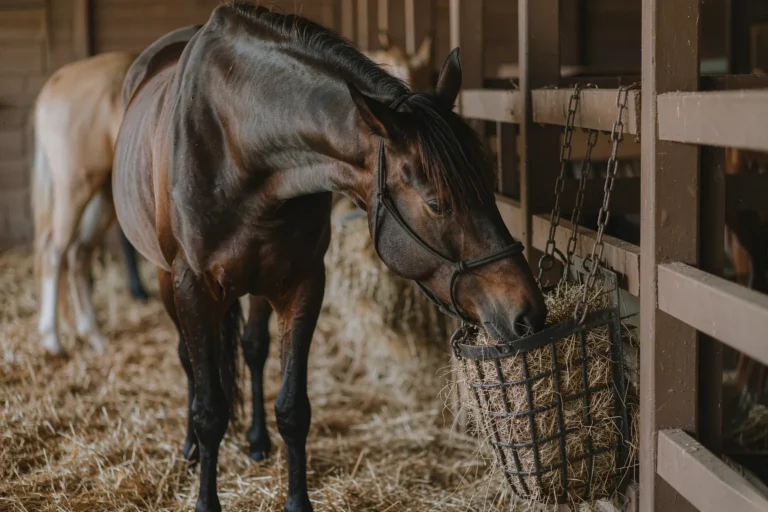
- Stop feeding hay off the floor of a dusty box. Hay fed at floor level in a stabled horse puts the horse’s nose directly into the dust cloud. A hay net or a feeder outside the stable door, or feeding from a rack in an open-air area, changes the exposure without changing the ration.Check Price
As an Amazon Associate we earn from qualifying purchases. Nothing on this list replaces your vet’s advice on your horse.
Five questions worth asking your vet
Bring these written down. A fifteen-minute appointment goes very differently when you are not trying to remember them from a website.
- Is this asthma, infection, or both — and does the BAL confirm it?
- How severe is the airway inflammation on a grading scale?
- What is my environmental action list, in priority order?
- Do we need steroids, and what is this horse’s laminitis risk if we use them?
- What is the plan if the horse does not improve in four weeks?
Related reading
Sources & further reading
- Merck Veterinary Manual — Recurrent Airway Obstruction in Horses
- AAEP — Equine Asthma / Heaves
- UC Davis Center for Equine Health — Equine Asthma
- Couëtil et al., ECEIM consensus statement on equine asthma (J Vet Intern Med, 2016)
Price ranges are compiled from published U.S. veterinary fee surveys and practice websites for 2025–2026. Regional variation is large; treat every number here as a planning figure and ask your own clinic for a written estimate before treatment begins.
Guides
Gear & Reviews
Popular Reads