How Much Hay Does Your Horse Need? The Per-Month Math
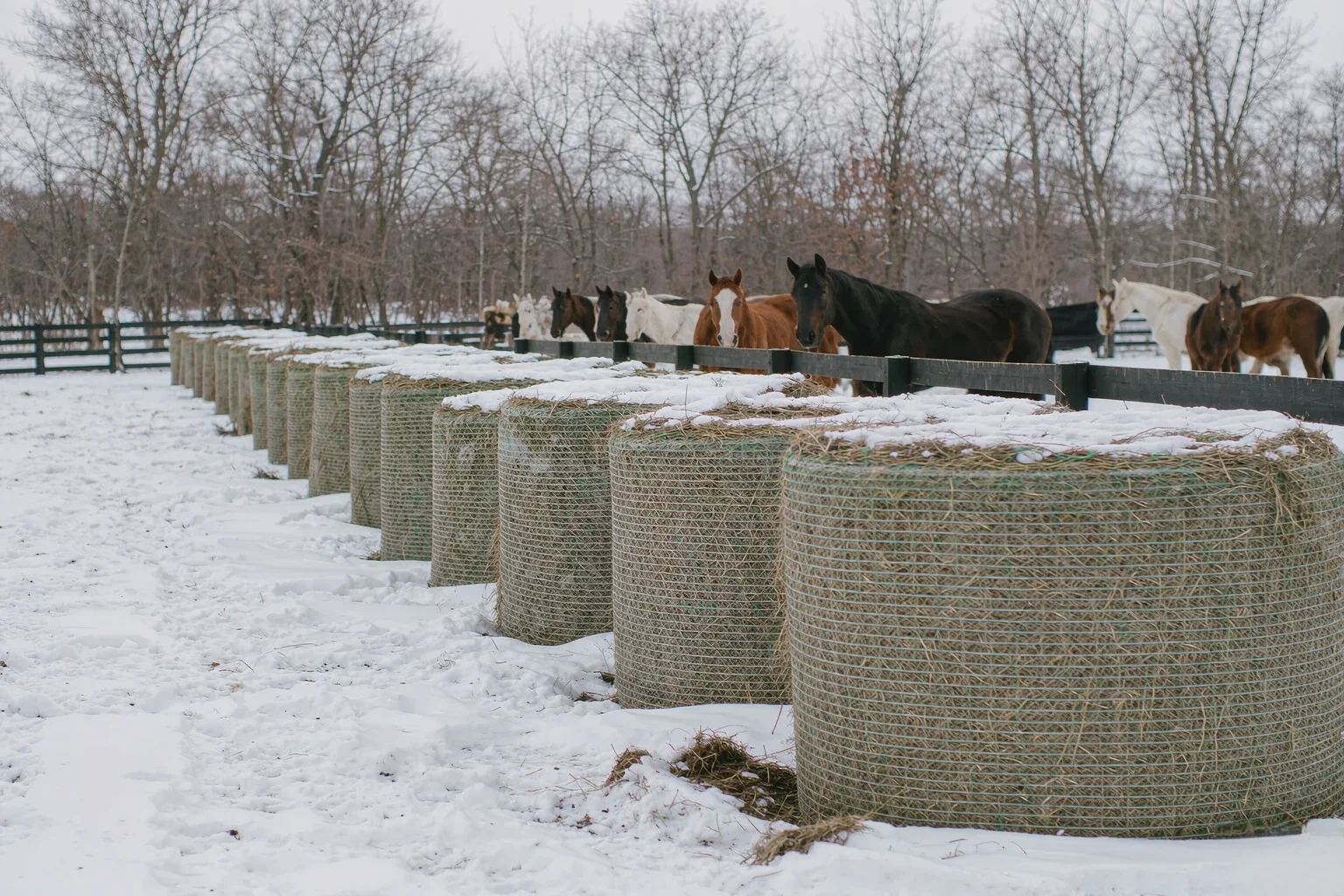
A simple formula that turns body weight into bales per month — and a feed budget you can defend.
The Formula
Daily forage = 1.5–2.5% of body weight. Most pleasure horses sit near 2%:
| Horse weight | Daily hay | Monthly hay |
|---|---|---|
| 900 lbs | 14–22 lbs | 420–660 lbs |
| 1,100 lbs | 17–27 lbs | 510–810 lbs |
| 1,300 lbs | 20–32 lbs | 600–960 lbs |
Converting to Bales
Small square bales run 40–60 lbs depending on region. A 1,100-lb horse at 2% needs roughly 12–16 small bales per month — at $8/bale, $96–$128/month, before waste.
The Waste Multiplier
Free-fed round bales can waste 20–40% to weather and trampling. Slow-feed nets cut that meaningfully — which is why a $25 net is one of the fastest paybacks in horsekeeping.
Pasture Isn’t Free Hay
- Lush spring grass ≠ year-round supply — most US horses need supplemental hay 6+ months
- Winter/drought pastures can supply almost nothing while looking like “grass”
Feed-Room Math Tools
- Livestock scale or weight tape — get the weight right firstCheck Price
- Slow-feed hay nets — stop paying for trampled hayCheck Price
- Digital hay scale for consistent rationsCheck Price
Hay prices by region: our 2026 hay cost guide.
Refining the Number for Your Horse
The 1.5–2.5% rule is a starting range, not an answer. Four factors move an individual horse within it:
- Body condition. An overweight horse (BCS 7+) should be dropped to 1.5% of target weight, not current weight — feeding 1.5% of a fat horse’s actual weight still overfeeds. A hard keeper at BCS 3–4 goes to 2.5–3% of target.
- Workload. Light pleasure work stays at ~2%. Regular 45-minute rides three times a week is still “light.” Horses in 5–6 day training move to 2.2–2.5%.
- Life stage. Lactating mares and growing 2-year-olds run 2.5–3%. Seniors with poor dentition may need hay soaked or cubed, but the total tonnage does not drop — the form changes.
- Climate. Below roughly 45°F, forage requirement rises about 1% per degree of cold stress because hay fermentation is the horse’s heat source. A winter clip or a cold snap is a 5–15% feed increase, not a grain increase.
Hay Quality Changes the Quantity
A tonnage number assumes average grass hay at roughly 7–9 Mcal per kg of digestible energy. Reality is wider:
- Rich early-cut alfalfa-mix can run 20–30% hotter — a horse on it needs less weight of hay, and easy keepers often need it diluted with grass hay.
- Late-cut, coarse, rained-on hay can be 15–20% below — horses eat more to get the same energy, which is why the same horse can drop weight on a cheaper bale.
- A $40 forage analysis replaces all of this guessing with actual numbers, and it is the only way to know what your horses are eating. Every second or third hay purchase should have one.
Weigh, Don’t Guess
- Digital hanging scale — Turn flakes into poundsCheck Price
- Galvanized metal trash can — Buy in bulk without the bugsCheck Price
- Small wall whiteboard — Post the month’s ration on the stall doorCheck Price
Worked Examples at 2026 Prices
| Horse | Weight | BCS | Hay/day | Bales/mo (50 lb) | Cost/mo @ $14 |
|---|---|---|---|---|---|
| Easy-keeping trail horse | 1,000 | 5–6 | 15 lb (1.5%) | 9 | $126 |
| Average pleasure horse | 1,100 | 5 | 22 lb (2%) | 13 | $182 |
| Hard-keeper in work | 1,100 | 4 | 30 lb (2.7%) | 18 | $252 |
| Overweight pony (target wt) | 800 | 7 | 12 lb (1.5% of target) | 7 | $98 |
| Senior with dental issues | 1,000 | 4 | 25 lb soaked/cubed | 15 | $210 |
The Winter Correction
Cold weather is where hay budgets break. A horse’s critical temperature (below which it must burn energy to stay warm) is roughly 45°F for an unclipped horse with a summer coat, dropping to 15–20°F for one with a full winter coat, lower still with a blanket. For each degree below critical, add roughly 1% more forage:
A 1,100-lb horse with a winter coat at 20°F is roughly 10–15 degrees below critical — 10–15% more hay, which is 2–3 extra pounds per day, or roughly 2 additional bales a month. Clipped horses in work through a northern winter can need 25–30% more. Budget the winter increase in the fall, not when the horse is already losing condition in January.
Common Mistakes in Hay Budgeting
- Counting hay by the flake. Flake weight varies by a factor of two between bales. Weigh one flake from your actual bales once — the number is usually surprising.
- Forgetting round-bale waste. A round bale on the ground loses 25–40% to trampling and weather. The slow-feed cover from the hay-net guide cuts that to 10–15% and changes the math accordingly.
- Buying on price per bale without weight. A $9 bale at 40 lb costs more per pound than a $14 bale at 55 lb. Always compute cost per pound, or per ton when buying in bulk.
- Not storing enough for winter. Buying hay monthly means buying at the winter price. Buying the whole season in summer, even on a payment plan, typically saves 15–30%.
Guides
Gear & Reviews
Popular Reads