Equestrian Disciplines Explained: Every Major Horse Sport, and How to Pick One
Dressage, reining, eventing, barrels, endurance, driving — the horse world has more sports than most beginners realize. This guide maps every major discipline in plain language: what you actually do in each, what it costs to start, and how to choose the one that fits you.
What a “Discipline” Actually Is
A discipline is a competitive tradition with its own tack, clothing, gaits, judging rules and culture. The horse underneath barely changes — a well-trained horse that learns dressage could learn reining — but everything bolted on top of it, and everything expected of the rider, is different. That is why the discipline you pick as a beginner quietly shapes your first two years: it decides what lessons teach, what tack you buy, and which barn you feel at home in.
The sport divides into a few large families. English disciplines (dressage, jumping, eventing, hunters) come from European military and fox-hunting traditions and ride with a close-contact saddle and two hands on the reins. Western disciplines come from working-cattle culture — one hand, a heavier saddle, an emphasis on the horse managing itself. Racing, distance riding, driving and a handful of specialty sports stand slightly apart. Below, each family in detail.
The Map: Every Major Discipline at a Glance
| Discipline | Family | In one sentence | Cost to start | Best for |
|---|---|---|---|---|
| Dressage | English | Train the horse to perform precise, increasingly difficult movements from invisible aids — the ballet of riding | $$ | Riders who love precision and progress you can measure |
| Show Jumping | English | Clear a course of colorful fences inside a time limit; faults for knocks and refusals | $$–$$$ | Thrill-seekers who want objective scores |
| Eventing | English | Three tests in one: dressage, cross-country over solid obstacles, then show jumping | $$$ | All-around riders with grit and stamina |
| Hunters & Equitation | English | Jump natural-style fences while a judge scores the horse’s (hunter) or rider’s (equitation) form and rhythm | $$$ | Riders who enjoy polish, ring craft and horse shows |
| Saddle Seat | English | Ride high-trotting American breeds (Saddlebreds, Morgans) in a flat saddle with exaggerated animation | $$ | Show-ring personalities who love the big trot |
| Western Pleasure | Western | Group class judged on the horse’s smooth gaits, calm manners and responsiveness | $–$$ | Relaxed riders; the classic youth and amateur start |
| Reining | Western | Western dressage: prescribed patterns of spins, sliding stops and fast circles, judged on quality | $$–$$$ | Riders who want athletic precision with cowboy roots |
| Barrel Racing | Western | Sprint a cloverleaf pattern around three barrels against the clock | $–$$ | Speed lovers; one of the most accessible timed sports |
| Cutting & Ranch Horse | Western | The horse separates one cow from the herd and holds it — mostly the horse’s job, entirely addictive | $$$ | People with access to cattle and serious horse flesh |
| Rodeo timed events | Western | Team roping, tie-down roping, breakaway and steer wrestling from the working ranch tradition | $$$ | Competitive all-rounders and ropers |
| Thoroughbred & QH Racing | Racing | Flat-out speed on the track; an industry to work in more than a sport to board with | $$$$ | Career professionals and owners |
| Endurance | Distance | Complete 50–100 mile trails within time windows while passing strict vet gates | $$–$$$ | Long-distance riders who love strategy and trail |
| Competitive Trail | Distance | Judged rides over marked distance and terrain, scored on condition and horsemanship | $–$$ | Trail riders who want a score without racing |
| Driving | Harness | Put the family in the cart: pleasure driving, marathon and cone competitions with single or multiple horses | $$–$$$ | Non-riders, small ponies, and people who love turnouts |
| Vaulting | Specialty | Gymnastics and dance on a moving horse — the safest entry sport for small children | $ | Kids and gymnasts; team spirit |
| Para-Equestrian | English | Dressage with graded profiles and allowed adaptations, on the Paralympic program | $$–$$$ | Riders with disabilities; elite pathway exists |
| Polo | Specialty | Team ball sport on horseback; club chukkas make it more accessible than its reputation suggests | $$$$ | Team athletes with deep pockets or club access |
English Disciplines
English riding is built around a close-contact saddle, a steady two-handed rein contact and an emphasis on the rider’s position as an aid. If you learned to ride at a typical lesson barn in the eastern US, the UK or Europe, you started here.
Dressage
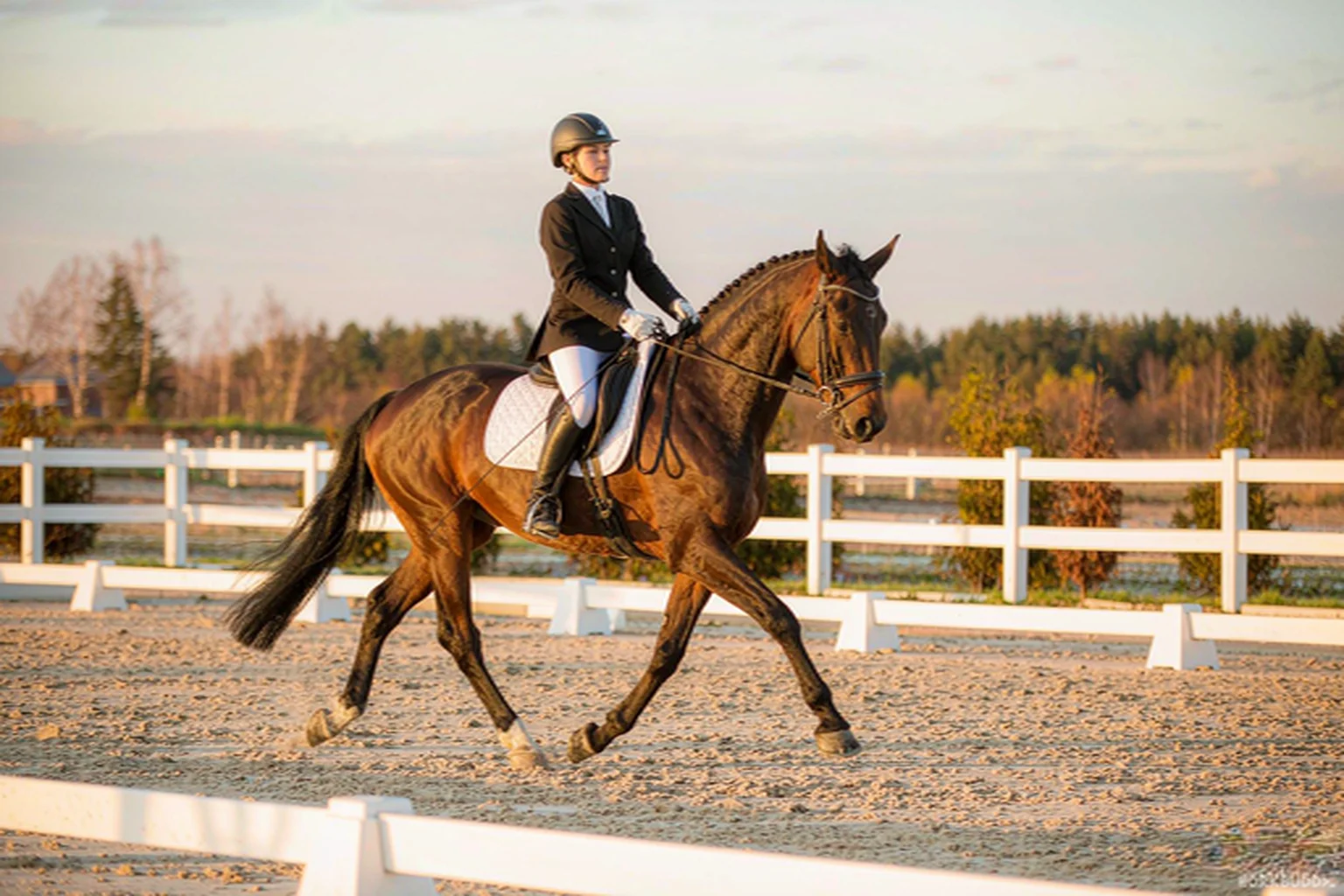
Dressage is systematic gymnastic training judged in a rectangular arena. You ride prescribed “tests” — memorized patterns of circles, transitions and lateral work — and a judge scores each movement from 0 to 10. The levels run from Introductory (walk-trot) to Grand Prix (piaffe, passage, one-tempis), so there is a measurable ladder for every stage of horse and rider. It is the discipline that underpins nearly all others: even barrel racers borrow dressage concepts, and every eventing competition opens with a dressage test. Competition is affordable at intro levels and famously expensive at the top, where the horses themselves cost as much as the real estate.
Show Jumping
Show jumping is the crowd-pleaser: a course of 8–16 colored fences ridden against the clock. Four faults for a rail down, four for the first refusal, elimination for a second — then a jump-off against the clock for clear rounds. The sport scales beautifully, from cross-rail classes at a schooling show to 1.60m Grand Prix. What beginners underestimate is that jumping is a dressage problem at speed: the fence is easy, the turns and rhythm before it are not. Most lesson barns introduce ground poles within the first year.
Eventing (Three-Day Eventing)
Eventing is the triathlon: one horse, one rider, three tests over one to three days. Dressage on day one; cross-country — galloping miles of terrain over solid logs, banks and water complexes at height-appropriate speeds; then show jumping on the final day to prove the horse is still fit and careful. It is the most demanding discipline on horse and rider fitness and the closest thing competitive riding has to a gamble on weather, footing and nerve. Entry levels (Beginner Novice, Novice) are genuinely beginner-friendly once you can jump confidently.
Hunters and Equitation
The hunter ring is judged on style, rhythm and consistency over natural-looking fences — the ideal is a horse that looks pleasant to ride across a field all day. Equitation classes judge the rider instead, which makes them the traditional training ground for future professionals. The catch, and it is a real one: the hunter world rewards polish, and polish costs money in tack, clothes, trainer day fees and show entries. It is the most expensive way to enjoy an unjudged activity.
Saddle Seat
Saddle seat rides the high-trotting American breeds — American Saddlebred, Morgan, Arabian — in a flat-cutback saddle with the rider sitting slightly behind the motion, hands held high. The goal is animation: the horse’s legs describe enormous, showy arcs. It is a regional American and South African tradition with a devoted show culture, and it is friendlier to beginners than it looks, because lesson programs on breeds like Morgans and Saddlebreds are common in the Midwest and Southeast.
Western Disciplines
Western riding descends from the working cattle ranch: a heavier saddle designed for long days, a one-handed neck-rein, and a deep cultural preference for a calm, self-carried horse. Beginner lessons on the western side tend to spend more time on control and less on equitation theory — and the discipline’s own sports are more accessible than most people expect.
Western Pleasure
The most common western class: a group of riders walks, jogs and lope on command while a judge ranks the horses on smoothness, cadence and manners. It has an unfair reputation as the “slow” class — in reality, producing a horse that carries itself quietly and correctly is a training achievement. For families, it is usually the cheapest show discipline to enter, because a competent school horse and a used saddle are enough to start.
Reining
Reining is western dressage with dust: a judged pattern of large fast circles, small slow circles, flying lead changes, 360-degree spins and the sliding stop — twenty-plus feet of sliding on the hindquarters. It became an Olympic-discipline demonstration sport and has a professional league, but schooling shows welcome beginners on any breed. The specialized sliding plates and footing make it one of the more equipment-sensitive western sports.
Barrel Racing
Barrel racing is the easiest timed sport to explain: run a cloverleaf around three barrels, fastest clean time wins, a tipped barrel adds five seconds. It is dominated by women at the professional level, runs from small-town jackpots to the National Finals, and needs nothing more than a willing horse and a safe arena to start training the pattern. Fitness matters for the horse — the sprint is short, but the turns are violent — and the sport has the largest secondhand tack market in the west.
Cutting and Ranch Horse Events
In cutting, the horse and rider walk into a herd, the rider opens the rein hand, and the horse alone separates one cow and prevents it from returning — for two and a half judged minutes. It is the discipline where the horse is most clearly the athlete, and it runs on expensive, specially bred horses. Its broader family — ranch riding, ranch trail, working cow horse — has become the fastest-growing western show scene precisely because it rewards a useful horse instead of a decorated one.
Rodeo Timed Events
Team roping (header and heeler rope a steer’s horns and hind legs), tie-down and breakaway roping, and steer wrestling come straight from ranch work and live inside the rodeo economy. They need livestock, practice cattle and mentors, so they are learned in a community rather than a lesson program — but the college rodeo pipeline makes them a realistic competitive path for younger riders.
Racing: The Industry Sport
Racing — Thoroughbred flat racing, Quarter Horse sprint racing and Standardbred harness racing — is less a rider discipline than an industry with millions of participants and a professional workforce. Most horse owners experience it as fans or breeders rather than competitors. If racing attracts you, the realistic entries are via the racetrack backside (groom, exercise rider, trainer paths), the aftercare community that rehomes retired racehorses, or simply owning a small share through the growing micro-ownership platforms. Retired Thoroughbreds and Standardbreds also make superb eventing and barrel prospects, which keeps a second economy alive around the track.
Endurance and Competitive Trail
Endurance rides cover 50 to 100 miles in a day, and the real competition happens at the vet gates: horses are held to strict recovery-heart-rate criteria, and a horse deemed unfit is pulled — the sport’s governing rule is “to finish is to win.” It rewards horsemanship, pacing strategy and an Arab-type horse with a huge engine. Competitive trail (and its relation, ride-and-tie) scores condition, manners and horsemanship over shorter marked courses, and is the friendliest on-ramp for ordinary trail horses. If your goal is to see country on horseback rather than a ring, this family is your home.
Driving, Vaulting and the Specialty Sports
Driving ranges from pleasure carts to marathon carriages judged like a triathlon of dressage, marathon and cones — and it is the discipline where non-riders keep horses happily. Vaulting is gymnastics on the back of a horse moving on a lunge line; it is officially the safest way for small children to start around horses and builds balance that transfers to every saddle. Para-equestrian dressage is the Paralympic pathway, with rider profiles that permit adapted tack and helpers. Polo, horseball and mounted games round out the team sports; polocrosse deserves a special mention as the most fun you can have with a racquet and a beginner-safe horse.
English or Western: The Practical Differences
For a beginner the deep differences are fewer than the internet argues about: both traditions teach balance, timing and how to communicate through your seat and legs. The practical differences are tack cost, clothing, culture and what the horse does with its feet. We keep a full comparison in English vs Western riding; the short version is that the best discipline for you is usually the one with the best instructor within driving distance.
What Each Discipline Costs to Start
Discipline choice is a budget decision more than riders admit. The numbers below assume you start as a lesson student and later lease or buy; see our lesson cost breakdown and the full cost to own a horse in 2026 for the arithmetic underneath.
| Discipline | Monthly lessons | First-year gear | Show entry, typical |
|---|---|---|---|
| Western pleasure / barrels | $180–$400 | $250–$700 (used saddle, boots, helmet) | $25–$60/class |
| Dressage / jumping (English) | $200–$500 | $400–$900 (helmet, boots, half-chaps, breeches) | $35–$75/class |
| Hunters / equitation | $300–$700 | $700–$1,500 (show clothing adds up) | $60–$150/class plus trainer fees |
| Eventing | $300–$600 | $800–$1,500 (plus protective vest) | $150–$300/entry |
| Endurance | $0–$300 (self-ride common) | $300–$800 (tack plus crew kit) | $80–$150/ride |
| Vaulting | $100–$200 | $50–$150 (soft shoes, team uniform) | $20–$50 |
How to Choose: A Five-Step Decision
- Book lessons before you pick a tribe. Two months of general lessons at a barn that teaches both styles will tell you more than a hundred forum threads. Start with our adult beginner roadmap and what to expect at the first riding lessons.
- Match the discipline to your body and your week. Eventing wants fitness and free weekends; dressage wants patience and weekly consistency; barrels want an arena and a trailer. The best discipline is one whose logistics you can sustain — see what to wear to a first riding lesson so gear never surprises you.
- Budget the ladder, not the first rung. Intro classes are cheap everywhere. If showing motivates you, price the discipline’s show scene honestly — hunters and cutting run the steepest, western pleasure and barrels the friendliest.
- Ride the horse you have, or borrow one. A quiet grade horse can teach barrels, ranch riding and competitive trail. Specialized horses — a Grand Prix dressage mount, a cutting horse — matter at the top, not the start. If you eventually buy, our first-saddle guide and helmet picks cover the kit you actually need first.
- Give it a season, then re-decide. Disciplines share fundamentals, so nothing is wasted. Riders switch in both directions all the time — the western reiner with dressage flatwork and the dressage rider who has learned to gallop cross-country are both better for it.
Guides
Gear & Reviews
Popular Reads