What to Wear to Your First Riding Lesson (and What Barns Send You Home For)
What to Wear to Your First Riding Lesson (and What Barns Send You Home For)
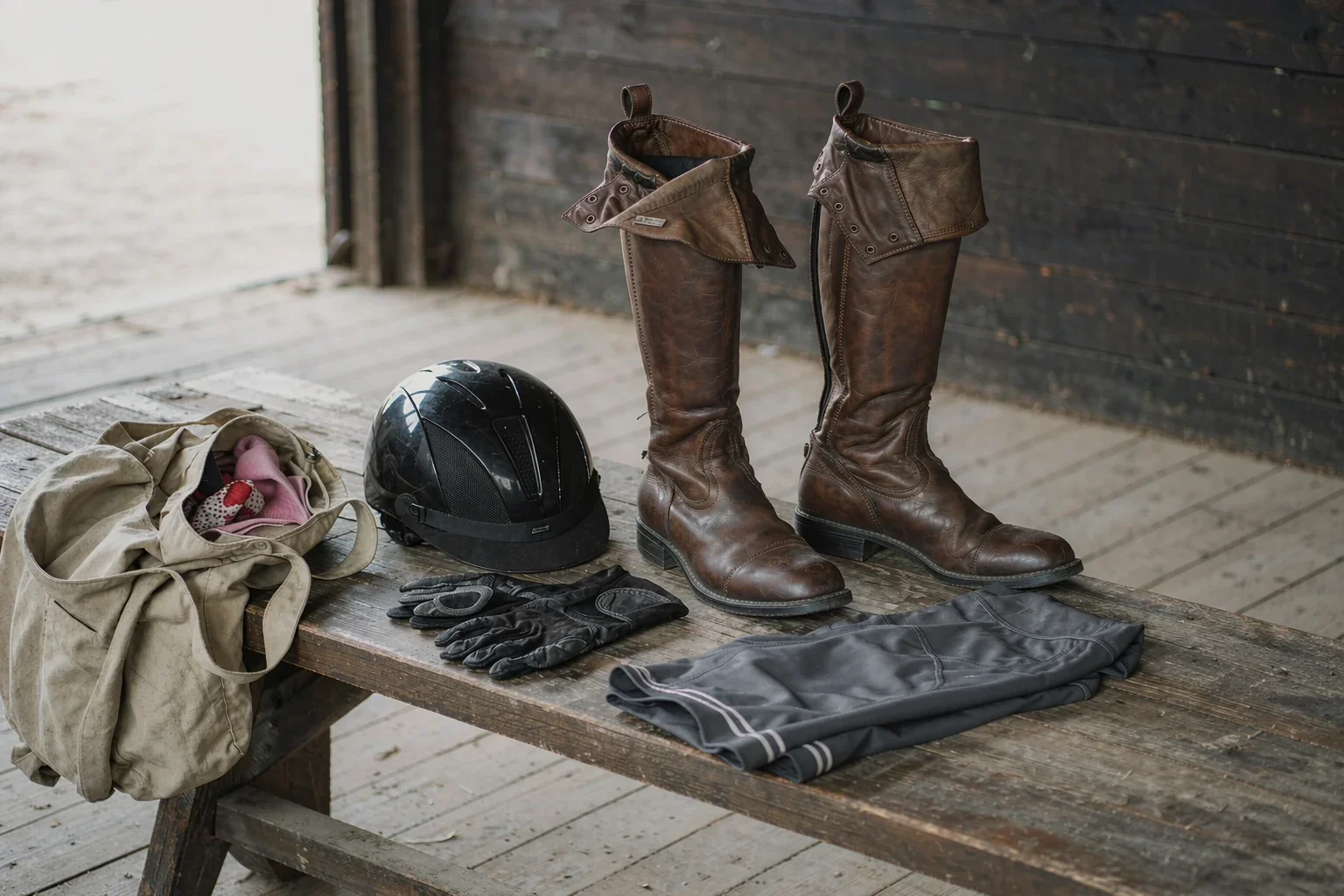
Three items decide whether you get on a horse: a certified helmet, a boot with a heel, and pants that do not grab the saddle. Everything else can wait months. Here is exactly what barns require in 2026, what they will genuinely turn you away for, and what a starter kit costs at three budget levels — including the $0 version.
- Nearly every barn requires three things: an ASTM F1163 / SEI-marked helmet, boots with a defined heel of about half an inch, and long pants
- Sneakers, sandals and heel-less rubber boots are the three most common reasons a beginner is sent home
- A complete beginner kit runs $165–$400; most barns lend a helmet and boots, so lesson one can cost you nothing but the lesson
- Half chaps plus paddock boots ($110–$260) do the same job as tall boots ($150–$400) for a beginner
- Nothing on your body should be loose, dangling or dangling-adjacent: no scarves, no long earrings, no hood cords
The three hard rules
Helmet
Boots and heels
Pants
Layers and small stuff
Bought too early
Three budgets
Night-before list
Riding gear has a strange cultural weight for something so ordinary. You do not need to look like a rider to start riding — you need to not fall off because of your shoes. The rules below are the ones instructors enforce because they have seen what happens when they do not.
The Three Hard Rules
Ask ten barns and you will get ten versions of the same three sentences. Helmet on, heel on, legs covered. Everything past that is comfort, weather or vanity.
| Item | Requirement | The reason, not the rule |
|---|---|---|
| Helmet | ASTM F1163 with SEI mark, fitted, chin strap fastened | A fall from 6 ft onto arena sand still produces a head injury |
| Footwear | Boot with a defined heel, closed toe, smooth sole | The heel stops your foot sliding through the stirrup; a lugged running sole can stick |
| Legwear | Long pants, no matter the temperature | Bare legs against leather and stirrup leathers means pinch marks and rubs |
| Gloves | Recommended, not required | Grip on a wet rein; blisters on day one are avoidable |
| Body protector | Optional except for cross-country jumping | ASTM F1937 rated; not needed for a first flat lesson |
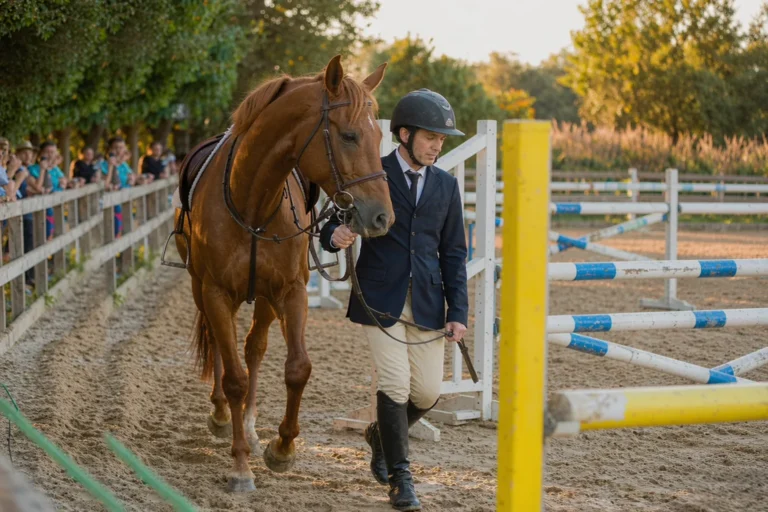
The list of things that get people sent home is short and consistent: running shoes, sandals, flip-flops, heel-less rubber wellies, shorts, and a bicycle helmet. A bicycle helmet is the one that surprises people — it is designed for a single impact at low speed from a different angle, and it has no peak or fixed harness rated for a fall from a horse.
The Helmet Is the Only Real Decision
Everything else on this page is about comfort. The helmet is about the next forty years of your life, which is why it is also the one item where the specification matters more than the brand.
What to look for. In the US, a riding helmet should carry ASTM F1163 and the SEI certification mark inside the liner. That combination is the legal minimum for instruction at most barns and the minimum you should accept for yourself. VG1 is the equivalent European standard; a helmet marked with either is fine, but a helmet with neither is a costume.
Fit matters more than price. A $300 helmet that rocks is less protective than a $70 helmet that fits. The test: the front edge sits about an inch above your eyebrows, the harness cups the base of your skull, and when you shake your head firmly the skin on your forehead moves with the helmet. If you can tilt it forward over your eyes, it is too big.
Replace it after a fall. The foam liner crushes once and does not spring back; a helmet that has taken a real impact is a helmet-shaped object. Manufacturers also commonly recommend replacement every five years because sweat and UV degrade the liner. Never buy a used helmet — you cannot see its history.
Prices for certified adult helmets in 2026 run about $60–$300. Rotational-impact liners (MIPS and similar) sit at the top of that range and are worth the money if you plan to jump. Our beginner helmet guide compares the certified options by fit shape rather than by logo.
Boots: Why the Heel Is the Whole Point
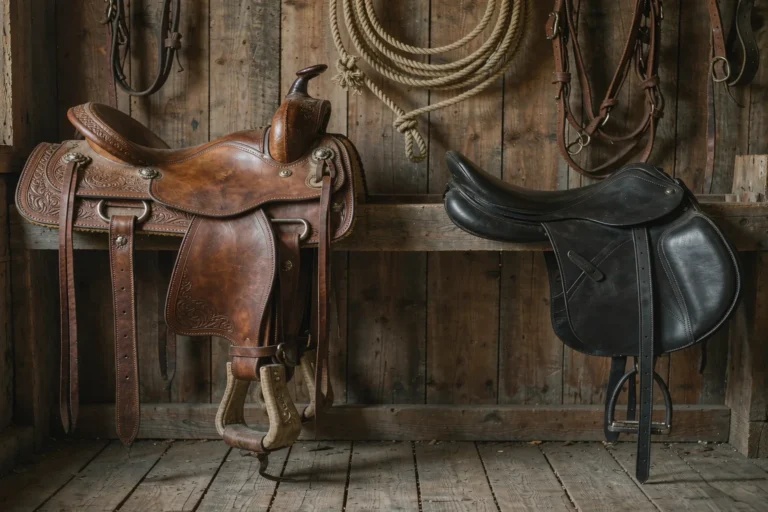
A stirrup is a metal loop about 4.75 inches wide. A smooth-soled shoe with no heel slides through it, and the classic equestrian injury is a foot caught in a stirrup while the horse keeps moving. A heel of roughly half an inch to an inch physically blocks that slide. This is not tradition; it is the reason the rule exists at every barn on earth.
| Option | Typical price | Verdict for lesson one |
|---|---|---|
| Paddock boots plus half chaps | $110–$260 | The standard beginner answer. Cheap, comfortable, and the chaps give calf grip |
| Tall field or dress boots | $150–$400 | Excellent, but do not buy before lesson ten — calf fit is a guessing game |
| Western boot with a riding heel | $90–$250 | Fine, especially if you are riding western; avoid roper soles with deep tread |
| Jodhpur boots with elastic sides | $60–$150 | Fine for English flatwork; must have the heel |
| Hiking boots or work boots | — | Acceptable in a pinch if they have a heel and a smooth sole; heavy and clumsy |
| Running shoes, sandals, wellies without a heel | — | Sent home. Every time |
Two fit notes that save money. Buy paddock boots in the size you wear in a normal shoe, not a size up — a loose heel is what causes the blister, not a tight one. And if you go the half-chap route, the chaps should be snug enough at the calf that they do not twist when you post; a chaps that rotates is a chaps that will chafe by minute twenty.
Boots and Chaps, Beginner Grade
- Leather paddock boots with elastic gusset — The one pair that works with half chaps or jeansCheck Price
- Suede half chaps — Grip and calf protection for a third of tall-boot moneyCheck Price
- Boot trees or shaper inserts — Leather that dries folded cracks at the ankle within a seasonCheck Price
Pants: Breeches, Tights or Jeans
Any long pants that let you open your hip will get you through a first lesson. The differences show up at lesson five, when friction starts to matter.
Breeches ($50–$150) are cut with a knee patch and a higher back waist, which is exactly where a saddle rubs. The knee patch is not decoration — it is the part that stops the leather from sanding your knee during rising trot.
Riding tights ($40–$110) are cooler in summer, dry faster, and many come with a silicone seat that grips the saddle. They double as gym leggings, which makes them the best value for a first season.
Jeans work for western lessons and for a one-off. Look for a flat inseam: a thick double-stitched seam sits exactly on the saddle’s seam and will leave a red line down your calf for two days. Avoid very loose legs that can catch on the saddle horn when you dismount.
What does not work: shorts (any discipline), leggings so thin the saddle seam prints through, and anything with a loose hem that can catch on a stirrup.
Layers, Hair, Jewellery and the Small Stuff
Layers. An indoor arena is cold at 8 am and hot at 11. A base layer plus a zip fleece beats one heavy jacket, and it means you can shed a layer without stopping the lesson to undress.
Hair. Tie it back, low and secure. Loose hair under a helmet itches, and loose hair near a horse’s face is a bite waiting to happen.
Jewellery. Nothing dangling: no long earrings, no necklaces outside your shirt, no bracelets, no rings you would grieve. Hoops catch on reins and on tack hooks.
Gloves. $15–$35 for synthetic leather with a reinforced rein finger. Beginners underestimate how much rein handling happens in the first month — your hands will thank you on day three.
Sunscreen and water. Outdoor arenas reflect light off sand. A 45-minute lesson in direct sun without sunscreen is a sunburn you will feel every time you sit down for a week.
Small Stuff That Actually Gets Used
- Riding gloves with reinforced rein finger — The first piece of gear beginners notice missingCheck Price
- Helmet liner or skull cap — Keeps a loaner helmet from being a weekly hygiene negotiationCheck Price
- Small canvas tote with a zip — Phone, keys and hair ties stay out of the arena sandCheck Price
Five Things Beginners Buy Too Early
- Tall boots. Calf fit is the hardest measurement in equestrian gear and your calf changes shape once you are riding three times a week. Buy them at month six, not week one.
- A show coat. You will not show for a year, and the cut that suits you depends on the discipline you end up in. When the time comes, a first show costs more than the coat.
- Spurs. An aid for a rider with an independent leg. On a beginner’s leg it is a nuisance to the horse; most instructors will take them off you anyway.
- White breeches. Beautiful, and every mark shows — including the ones from the saddle you are still learning to sit.
- A helmet bought online without trying it on. Fit is the safety feature. Buy from somewhere with a return policy, or get fitted at the barn first.
Three Budgets for a First Season
| Level | What you buy | Total |
|---|---|---|
| Borrow everything | Loaner helmet and boots from the barn, your own leggings and a pair of gloves | $0–$35 |
| Sensible starter | Certified helmet $60–$150, paddock boots $60–$140, half chaps $50–$120, gloves $15–$35 | $185–$445 |
| Comfort first | Better helmet with rotational liner, tall boots or good paddock boots, two pairs of riding tights, gloves, helmet liner | $400–$800 |
Against that, a single group lesson runs $40–$80, and the first year of riding on a school horse typically lands between $1,300 and $4,000 depending on frequency. Gear is not where the money goes. Frequency is.
The Night-Before Checklist
Pack this the evening before, not the morning of, because the morning of is when people discover their only long pants are in the wash.
- Helmet, or confirmation that the barn is lending one
- Boots with a heel, plus socks that cover the ankle
- Long pants with a flat inseam
- Gloves
- Water bottle and a layer you can take off
- Hair tie (bring two)
- Nothing dangling: no hoops, no scarf, no loose bracelet
Then read the barn’s own list, because individual programs add rules — some require a body protector for all jumping lessons, some ban jeans outright. And if you are still deciding which direction to ride in, our guide to choosing between English and western covers the tack, the cost and the seat differences without the snobbery.
Guides
Gear & Reviews
Popular Reads
Keep reading: English or western? How beginners should choose · What riding lessons really cost in 2026 · How to choose a riding barn: 12 red flags