How Often Should a Horse See the Farrier? (And What It Should Cost)
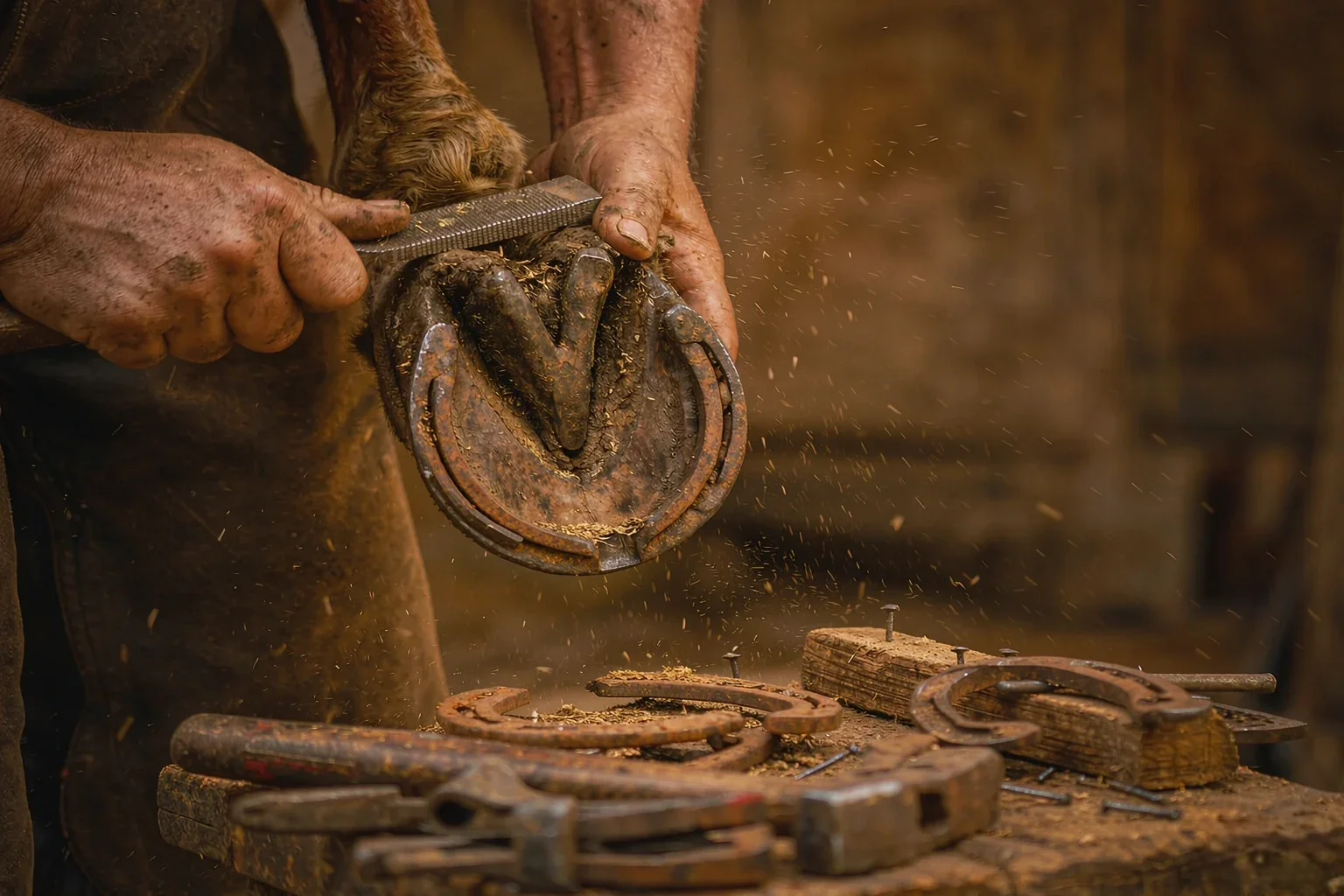
Every 6–8 weeks is the standard interval — whether barefoot or shod. Here’s why, plus what a trim and a shoe set should run you in 2026.
Hoof horn grows about 1 cm per month regardless of whether shoes are on. That growth rate — not tradition — is why the 6–8 week farrier cycle exists.
Barefoot vs. Shod Economics
| Option | Per visit | Per year (6–8 wk cycle) |
|---|---|---|
| Barefoot trim | $35–$75 | $280–$650 |
| Full shoe set | ~$147 median | $950–$1,300+ |
| Corrective/glue-on shoes | $200–$450+ | $1,600–$3,000+ |
Over 25 years, the barefoot-vs-shoes decision alone spans a $7,000–$32,000 difference.
Can Your Horse Go Barefoot?
Many pleasure horses can. Factors: hoof quality, workload, footing, and any pathology (thin soles, chronic lameness favor shoes). The transition takes months — expect tenderness on hard ground while soles callus.
Signs Your Schedule Is Right
- Hooves hold shape between visits; no major chips or flares
- Shoes stay tight at week 6, not week 2
- No persistent thrush, cracks, or heat in the hoof wall
Don’t Skip to Save Money
Stretching intervals to 12+ weeks saves ~$300/year and risks a lameness colic-season of vet bills. Hoof balance is preventive medicine — keep it on the calendar.
What the Farrier Actually Does at Each Visit
A trim is not cosmetic. At each visit the farrier is balancing three things: hoof angle relative to the pastern and shoulder, toe length relative to breakover, and wall/sole/frog proportions relative to the horse’s workload. Getting those three right is what distributes load through the leg; getting them wrong loads structures — navicular region, suspensories, the caudal heel — that fail expensively.
Shoeing adds: protection where wear exceeds growth, traction for the horse’s surface, and therapeutic changes (wedges, pads, clips) that redistribute load when the hoof cannot. A shoe cycle is typically 4–6 weeks in work, 6–8 weeks for barefoot trims, and the interval is set by growth rate — which varies with season, diet, and workload, not with the calendar.
The Cost Table, 2026
| Service | US median range | Frequency | Annual cost |
|---|---|---|---|
| Barefoot trim | $60–$120 | Every 6–8 wk | $450–$1,000 |
| Full set (4 shoes, steel) | $160–$300 | Every 4–6 wk in work | $1,400–$3,200 |
| Fronts only | $110–$200 | Common for light-work horses | $900–$2,000 |
| Reset (refit same shoes) | $90–$160 | Between sets when shoes hold | — |
| Aluminum or specialty shoes | $220–$400/set | Sport-specific | $2,000–$4,000 |
| Therapeutic work (pads, wedges, glue-ons) | $250–$500 | As prescribed | varies |
How to Tell if the Interval Is Right
Shoe-cycle planning is a growth-rate question, and there are three honest signals:
- Chipping and cracking before the farrier returns — the wall is growing past its support; the interval is too long.
- Shoes visibly loose or clinches raised — same signal, more urgent (a loose shoe is a safety issue on turnout).
- The hoof grows a clean inch between trims with no flares — the interval is right; do not shorten it because the calendar says so.
Growth slows in winter (roughly 30–40% less in cold months), which is why many horses go to 7–8 week cycles October through March and back to 4–5 weeks in spring.
Barefoot vs Shod: Deciding on the Horse, Not the Ideology
Barefoot works well for many horses on many surfaces — and it is a management program, not a default. The honest criteria:
- Barefoot candidates: good hoof wall quality, workload on forgiving surfaces, no pathological hoof shape, owner willing to manage a transition period of months.
- Shoe candidates: heavy work on abrasive or hard surfaces, thin soles or flat feet, therapeutic needs, horses whose walls chip faster than they grow.
The transition from shod to barefoot takes 6–12 months of new wall growth and usually involves boots or temporary tenderness. It is not a decision to make two weeks before show season.
Between Farrier Visits
- Hoof pick with brush — Ten seconds a day catches problems earlyCheck Price
- Leather work gloves — Hands survive the grit and the nippersCheck Price
- Hoof oil — Keeps walls from drying and crackingCheck Price
Being a Good Farrier Client
Farrier service quality tracks client behavior more than owners expect:
- Clean, dry horse, caught and ready. A farrier charging $200 for a set does not also want to catch your horse in a 10-acre field.
- Regular interval, same day each cycle. Farriers route efficiently; clients on the route keep the service.
- Teach the horse to stand. 15 minutes of groundwork with a young horse is worth more than any amount of apology.
- Pay on time and give notice if a cycle must be skipped. Farrier client lists are built on reliability, and the good farriers are the ones with waitlists.
- Discuss problems at the visit, not three weeks later by text — the farrier can see and fix an issue immediately; a text description rarely matches.
When Lameness Appears Between Visits
An abscess (sudden three-legged lameness, heat, strong digital pulse) is the most common between-visit cause and is farrier-vet territory, not a waiting matter. Chronic subtle lameness that follows a farrier visit by a few days is worth a phone call — sometimes the trim angle needs adjusting, sometimes the timing is coincidence and the underlying issue surfaced with work. Either way the farrier and vet working together is the standard of care, and the horses that do best long-term are the ones whose hoof care is a conversation rather than a service transaction.
Between-farrier care
- Hoof pick with brush — Daily picks catch thrush before it becomes a $200 vet callCheck Price
- Hoof conditioner — Dry-summer cracks cost a cycle; $15 of oil prevents themCheck Price
- Hoof boots — The trail-day backup for thin soles while you wait for the next visitCheck Price
Guides
Gear & Reviews
Popular Reads