AAEP Core Vaccines, Explained: What Your Horse Needs and When
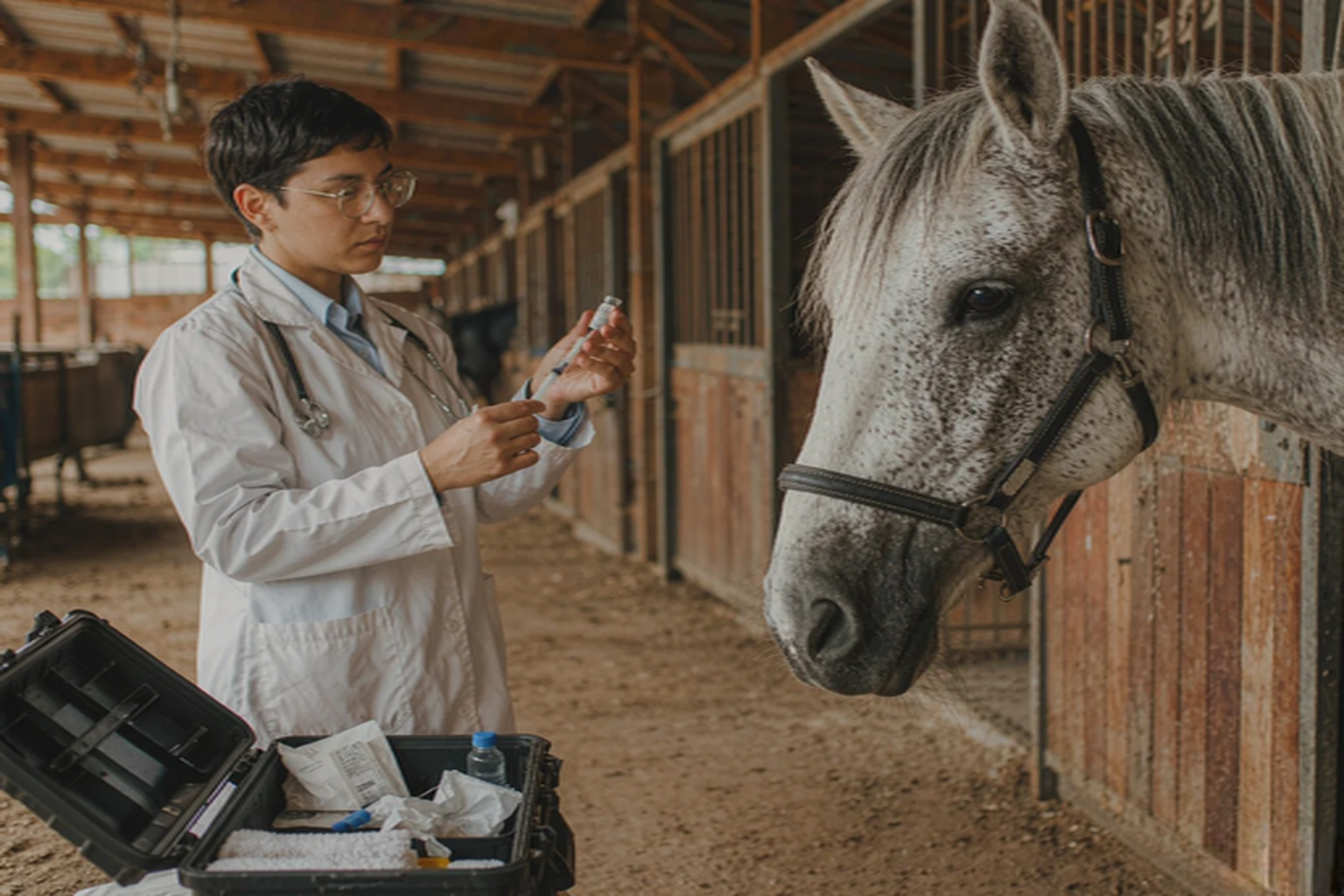
Five diseases, one annual schedule, roughly $120–$200 a year. The cheapest insurance policy in horse ownership.
The American Association of Equine Practitioners (AAEP) splits vaccines into core — recommended for every horse in North America — and risk-based, depending on exposure.
The Core Five
| Vaccine | Protects against | Typical schedule |
|---|---|---|
| Eastern/Western Encephalomyelitis (EWT) | Mosquito-borne neurologic disease | Spring annual; 6-mo booster in hot climates |
| West Nile Virus | Mosquito-borne neurologic disease | Spring annual |
| Tetanus | Wound-borne infection | Annual |
| Rabies | Fatal, zoonotic | Annual |
Common Risk-Based Additions
Flu/rhinopneumonitis (EHV-1/4) for horses that travel or mix with others; Potomac Horse Fever in endemic river regions; Strangles where exposure risk exists. Your vet will map these to local risk.
Why Timing Matters
Most core vaccines are timed before mosquito season — spring in the north, year-round rotation in the south. Immunity from some products wanes at six months, which is why 67% of owners have their vet administer vaccines (AHP 2025 survey) and put boosters on a calendar instead of remembering them.
Cost Context
Routine vet care including vaccines runs $400–$900/year. Compare that to a single neurologic disease case — often fatal, always five figures if survivable. This is the easiest yes in horse ownership.
Why “Core” Means Every Horse, Everywhere
The AAEP’s core list is not a rating of how dangerous each disease is in your area — it is a statement that these five are either (a) widespread and endemic, (b) uniformly fatal, or (c) transmissible to humans. Rabies is rare in horses, kills every unvaccinated horse that contracts it, and exposes the whole household during diagnosis. Tetanus lives in soil everywhere and needs only a small wound. EWT and West Nile are mosquito-borne and follow the birds; your county’s case count last year predicts nothing about this year.
The practical consequence: there is no horse for whom the core five are optional. A retired pasture pet on a private farm still needs all five, and skipping them saves $120–$200 a year against diseases where a single case costs $3,000–$10,000 in treatment — if treatment is even possible. For EWT and rabies, it usually is not.
What Each Vaccine Actually Prevents — and the Failure Math
No vaccine is 100%. What the core vaccines deliver is population-level protection that changes the outcome curve:
- Tetanus — nearly 100% fatal when unvaccinated; vaccinated horses survive the overwhelming majority of exposures. This is the most cost-effective vaccine in all of veterinary medicine.
- Rabies — 100% fatal, no treatment, zoonotic. Vaccination is the entire defense, for the horse and for the humans handling it.
- EWT (Eastern/Western encephalomyelitis) — 75–90% case fatality for EEE. The vaccine is highly effective; the reason cases still occur is unvaccinated horses, not vaccine failure.
- West Nile — roughly 33% case fatality. Vaccinated horses that do contract it have dramatically milder courses.
Risk-Based Vaccines: How to Decide What Else to Add
Risk-based vaccines are chosen with your vet against four questions:
- Does the horse travel or board where others do? → Equine influenza and EHV-1/4 (rhinopneumonitis). Any barn with traffic is an exposure environment; show barns are high-dose ones.
- Is there strangles in the region or the barn’s history? → Streptococcus equi vaccination, with the caveat that intranasal products have specific handling rules.
- Are ticks a real presence? → Potomac Horse Fever in river valleys; Anaplasmosis in tick country.
- Is Leptospirosis in the area? → Lepto vaccination, increasingly standard in wet regions — it is also a cause of recurrent uveitis (moon blindness).
A typical pleasure horse in a suburban US setting adds flu/EHV in the spring and, depending on region, one or two more. The realistic total spend with risk-based additions is $180–$350 a year, still trivial against the cost of one neurologic case.
Titers, Schedules and the Reality of Boosters
Two scheduling points owners argue about, with the evidence on each:
“Can I just do titers instead of boosters?” Titer testing measures antibodies, which is a fair proxy for protection against systemic diseases (tetanus, rabies to a degree) but a poor one for the mosquito-borne encephalitides, where protection depends on neutralizing capacity at the blood-brain barrier. The AAEP’s position is that core vaccination continues on schedule regardless of titer; discuss titers as a supplement for risk-based decisions, not a replacement for the core five.
“Why does WNV need a spring booster in the South?” Mosquito seasons are long, antibody levels wane over 6–9 months, and the case season peaks in late summer. A horse vaccinated once in 2024 is largely unprotected by August 2026 — which is precisely when the mosquitoes carrying it are most active.
The Cold Chain, Handled
- Refrigerator thermometer — Vaccine fridges run warmer than you thinkCheck Price
- Small hard cooler — Transport doses without cooking themCheck Price
- Sharps disposal container — The legal way to handle needlesCheck Price
Cost Breakdown, Line by Line
| Item | Typical 2026 cost |
|---|---|
| Core five vaccines (product) | $70–$120 |
| Farm call / exam (often required) | $50–$95 |
| Rabies tag & filing (some states) | $10–$25 |
| Flu/EHV booster (risk-based) | $35–$60 |
| One regional risk-based vaccine | $30–$55 |
| Typical annual total | $195–$355 |
One note on self-administration: rabies vaccination by an owner is not legally recognized in most US states, which means an unvaccinated-in-the-eyes-of-the-law horse that bites someone — or is bitten — is handled as unvaccinated. That single fact is why most vets recommend having rabies done professionally even if the rest are owner-given.
Record-Keeping: The Part Nobody Does Until It Matters
Keep a vaccination record per horse with: date, product, lot number, vet or administrator, and route. It matters in four situations: interstate travel (health certificates reference vaccination dates), sale (buyers ask), boarding contracts (most require proof), and disease outbreak trace-back (a barn with clean records containing EHV-1 is handled very differently from one without).
A photo of the vet’s invoice, stored in the horse’s folder on your phone, satisfies all four. The paper Coggins-and-vaccines envelope in the tack room does not survive, and a vet’s memory of “we did rabies in the spring I think” is not a record.
Vaccine-day essentials
- Vaccine transport cooler — Safe transport for spring shots and medicationsCheck Price
- Medical record binder — AAEP schedules are simple to follow on paper, and boarding barns will ask for itCheck Price
- Ice boot set — Post-injection swelling responds fast to coldCheck Price
Guides
Gear & Reviews
Popular Reads
Keep reading: Fecal egg counts: the modern deworming schedule