The Barn First-Aid Kit: What Vets Actually Want You to Have
Why Most Kits Fail
Walk into a tack shop and you can buy a “complete” first-aid kit in a plastic case for $89. Open it and you will usually find thirty items, of which maybe eight matter. The rest is filler: tiny alcohol swabs that dry out, a blunt pair of scissors, two squares of gauze, a roll of tape that will not stick to hair. When something actually goes wrong at 9pm on a Sunday, that kit does not help you.
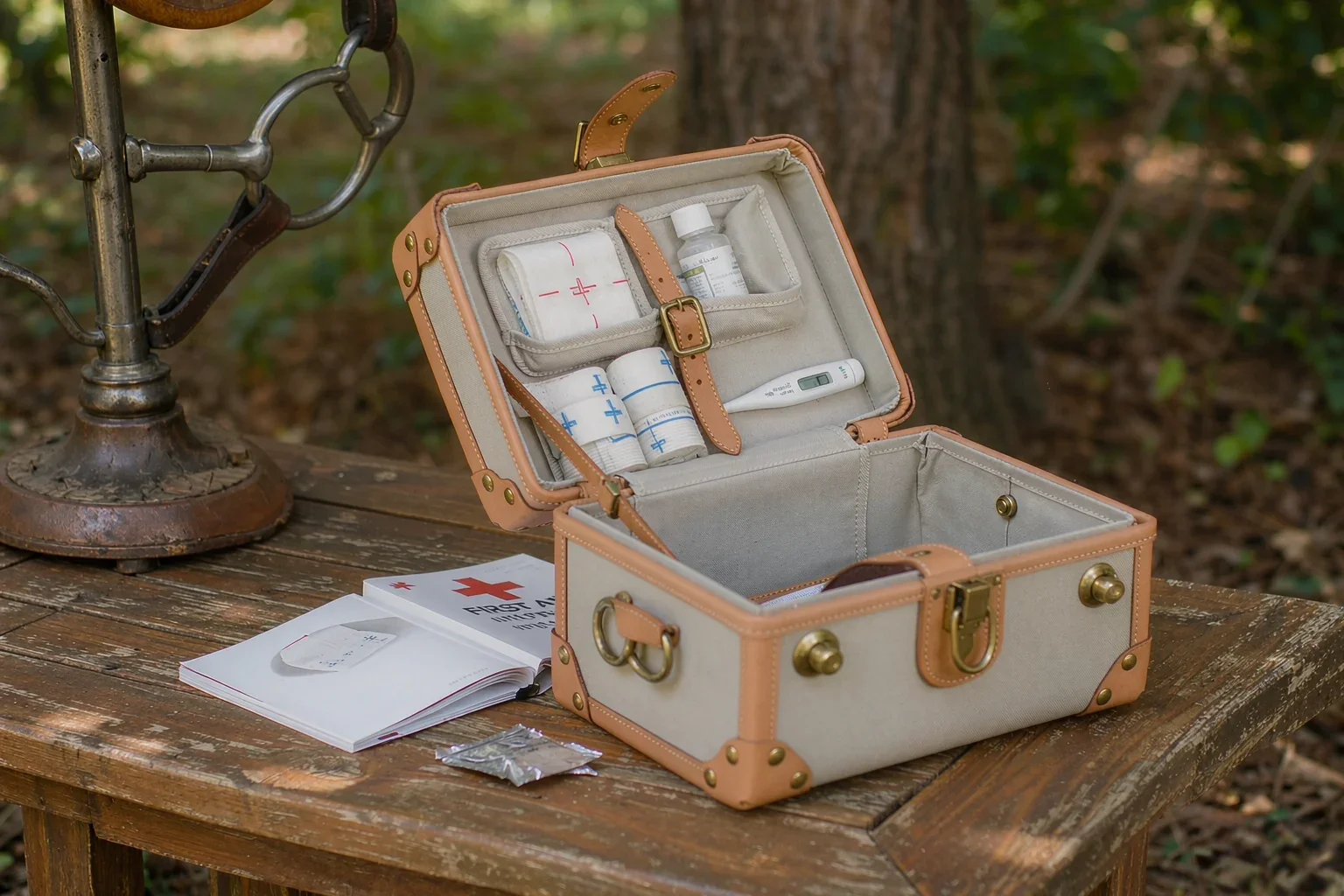
The kit that works is built around one question: what do I need in the ten minutes before a vet can get here? For a horse, that window is almost always about the same four things — taking a temperature, listening to gut sounds, controlling bleeding, and keeping a wound clean — plus one more that people forget: being able to describe what you are seeing to a vet who is not standing next to you.
Everything below is chosen to serve one of those five jobs. If an item does not help you do one of them, it does not belong in the kit.
The Core Kit
These ten items cover the overwhelming majority of real emergencies. Total cost is roughly $130–$280 bought new, and most of it is a one-time purchase — only gauze, wrap, saline and gloves get consumed.
| Item | Why it’s in the kit | Price |
|---|---|---|
| Digital thermometer + lube | Fever is the first signal in most emergencies | $10–$25 |
| Stethoscope | Gut sounds and heart rate — data your vet needs by phone | $20–$60 |
| Self-adhesive bandage wrap | Wound support and bandaging practice | $5–$12/roll |
| Non-stick gauze pads | Wound cover without tearing healing tissue | $8–$20 |
| Saline flush | Cleaning wounds and eyes | $5–$15 |
| Vet wrap scissors | Cutting bandage without cutting horse | $8–$20 |
| Hoof pick + poultice boot | Abscess management between vet visits | $15–$45 |
| Clippers / scissors | Clearing hair for wound assessment | $25–$60 |
| Latex gloves | Everything | $8 |
| Emergency contact card | Vet, back-up vet, trailer owner, surgical hospital | $0 |
What Each Item Is Actually For
Thermometer — the single most important purchase
A horse’s normal rectal temperature is 99.5–101.5°F (37.5–38.6°C). Anything at or above 102°F is a genuine fever and changes the urgency of almost every other symptom. A horse that is “a bit off” with a temperature of 103.5°F is a potential emergency; the same horse at 100.8°F is usually a wait-and-watch case. That distinction is the difference between a $180 farm call and a $4,000 hospital stay.
Buy a flexible-tip veterinary digital thermometer, not a human one. Human thermometers are too short for a horse’s rectum and the rigid tip is a genuine injury risk if the horse clenches. Keep a tube of water-based lubricant in the same bag — a dry thermometer is uncomfortable and you will stop using it.
Practice this when the horse is healthy. Take the temperature once a week for a month so the horse learns it is routine and so you learn what this horse’s normal actually is. Some horses run 99.2°F, some run 101.3°F. Knowing your baseline is worth more than any reference range.
Stethoscope — because “no gut sounds” is a diagnosis
If you call a vet about a horse with a mild colic, one of the first questions will be whether there are gut sounds. Without a stethoscope you cannot answer, and the vet has to guess. With one, you can say “gut sounds present in all four quadrants, normal rate” or “gut sounds absent on the right flank for two hours.” That is the difference between advice to hand-walk and an immediate visit.
Place the stethoscope just behind the last rib and listen in four spots — upper and lower, left and right. Normal is a soft gurgle every few seconds. Silence, or a high-pitched ping, is abnormal. Also learn to take a resting heart rate: normal adult is 28–44 beats per minute. A resting rate over 60 with a normal temperature is a pain signal, and a rate that keeps climbing is one of the most reliable predictors of a horse that is getting worse rather than better.
Bandage materials — buy more than you think
Wounds on legs get wrapped, and a leg wrap uses far more material than people expect: typically two to three rolls of self-adhesive wrap for one lower-leg bandage on an adult horse. Buy six rolls, not one. Add non-stick gauze pads (the “Telfa”-type, not woven gauze) because woven gauze bonds to a healing wound and tears it open when you change the dressing.
Keep the wrap and the gauze in the same bag as a proper pair of bandage scissors with a blunt lower blade. This is not fussiness — a horse that is in pain will move, and a sharp-pointed household scissors against a struggling leg is how people cut horses instead of bandages.
Saline — the most underrated item in the kit
A bottle of sterile saline (the kind sold for contact lenses or wound irrigation) does two jobs: flushing grit and debris out of a wound before you can see how deep it is, and flushing a contaminated eye. Both are common, both are painful, and both are dramatically easier to handle if you have saline on hand rather than improvising with a hose.
Do not use hydrogen peroxide on a horse’s wound. It is cytotoxic — it kills the healing cells along with the bacteria — and it has no place in a modern equine first-aid kit despite the fact that almost every old barn has a bottle of it.
Hoof kit — the most common after-hours call
Abscesses are the single most common cause of a horse that is suddenly three-legged lame. The sequence is almost always the same: sudden severe lameness, heat in the hoof, a strong digital pulse, no wound visible. A hoof pick lets you clean the sole so you can actually see; a poultice boot lets you apply a drawing poultice and keep it on overnight while you wait for the farrier.
This is not a substitute for veterinary care, but it is the difference between a horse standing comfortably in a stall with a wrapped hoof and a horse standing in a dirty stall with an open abscess and no protection.
The contact card — the item that saves the most time
A laminated index card, taped inside the kit lid, with five phone numbers: your regular vet, the emergency/after-hours vet, a back-up vet in the next county, a neighbour with a trailer, and the nearest surgical hospital. Add your horse’s name, age, weight in pounds, and any chronic condition or medication.
In an emergency you will not be able to think of these numbers, and your phone may be dead or in the house. The card costs nothing and it is the item people most often wish they had made.
Restock Before You Need It
- Bulk vet wrap — The item that always runs outCheck Price
- Horse wound spray — One-step clean on the panicky dayCheck Price
- Horse ice boot — Swellings respond to cold, fastCheck Price
What to Leave Out
Several things that come in commercial kits actively cause harm or create false confidence:
- Hydrogen peroxide — damages healing tissue, as above.
- Human painkillers — never give a horse ibuprofen, acetaminophen or aspirin without a vet’s direction; the doses and risks are completely different from human medicine and some are outright toxic.
- Antibiotic ointments — a wound that needs antibiotics needs a vet to choose the right one. A tube of ointment mostly delays the call.
- Tourniquets — a horse leg tourniquet applied by someone who has not been trained does more damage than the bleeding. Use direct pressure with a gauze pad and call the vet.
- Anything expired — check the kit twice a year. Saline and lubricant both expire, and expired saline is not sterile.
What to Add for Your Region
- Cold climates: extra wrap for ice bandaging legs
- Trail riders: compact kit that fits in a saddlebag, plus a hoof pick on the saddle
- Boarding barns: one communal trauma kit in addition to personal kits
Two additions worth considering if your situation calls for them: a headlamp (most emergencies happen after dark, and holding a phone torch while wrapping a leg does not work), and a wire cutter if you have wire fencing — a horse caught in wire is a genuinely time-critical situation.
The Discipline Rule
Stock the kit to stabilize and communicate, not to treat. Learn to take a temperature, count a pulse, and check gum colour — those three numbers change your vet’s triage decision. Gum colour in particular is something most owners never check: press a finger on the gum above the incisors, release, and count how many seconds until the colour returns. One to two seconds is normal; more than three suggests poor circulation and is a serious sign.
The goal of a first-aid kit is not to make you a vet. It is to keep the horse comfortable and stable long enough for a professional to arrive, and to give that professional enough information to arrive prepared.
Keeping the Kit Usable
The best kit in the world is useless if it is a shoebox at the back of the tack room with a leaking bottle of saline in it. Three habits make the difference:
- One bag, one place, always. A soft-sided bag with a handle that lives in the same spot, labelled on the outside, and known to everyone who handles the horse.
- Restock the same day you use something. Not “next time I’m at the tack shop.” Put a note on the bag the moment you take the last gauze pad out.
- Audit twice a year. Pick two dates you will actually remember — the start of show season and the first cold snap — and go through the bag: check expiry dates, check the thermometer battery, check the contact card is still current.
How Much Does It Cost to Run
The initial kit is a one-time $130–$280. After that, the consumables — gauze, wrap, saline, gloves — run about $30–$60 a year for a single horse, assuming you restock what you use and nothing more. That is roughly the cost of one bag of feed, and it is the cheapest insurance in horse ownership: a single avoided emergency call easily covers a decade of first-aid supplies.
Compare that with the alternative. An after-hours colic call typically starts at $250–$400 before any treatment; a surgical colic referral commonly runs $5,000–$10,000. The kit does not prevent either, but it reliably shortens the time between “something is wrong” and “a vet is doing something about it,” and that gap is where outcomes are decided.
First-aid essentials
- Veterinary digital thermometer — The single most useful piece of equipment you can ownCheck Price
- Veterinary stethoscope — Gut sounds and pulse — data your vet will ask forCheck Price
- Poultice boot — For abscess and hoof injuries between vet visitsCheck Price
- Pre-packed barn first-aid kit — Fastest way to cover the core list in one purchaseCheck Price
Guides
Gear & Reviews
Popular Reads
Keep reading: Traveling With Horses: the trailer-side biosecurity checklist