Best Slow-Feed Hay Nets: Cutting Waste and Colic Risk
Why Slow Feeding Is a Health Intervention
A horse’s stomach is small and designed to receive a trickle of forage for 16–20 hours a day. Two large flake-meals with nothing in between is the exact opposite of that design. The consequences are well documented: gastric ulceration rates in pleasure horses are estimated at 37–59% (higher in racehorses), cribbing and stall-walking are associated with meal-feeding, and hay thrown loose on the ground in a group setting gets wasted, contaminated, and fought over.
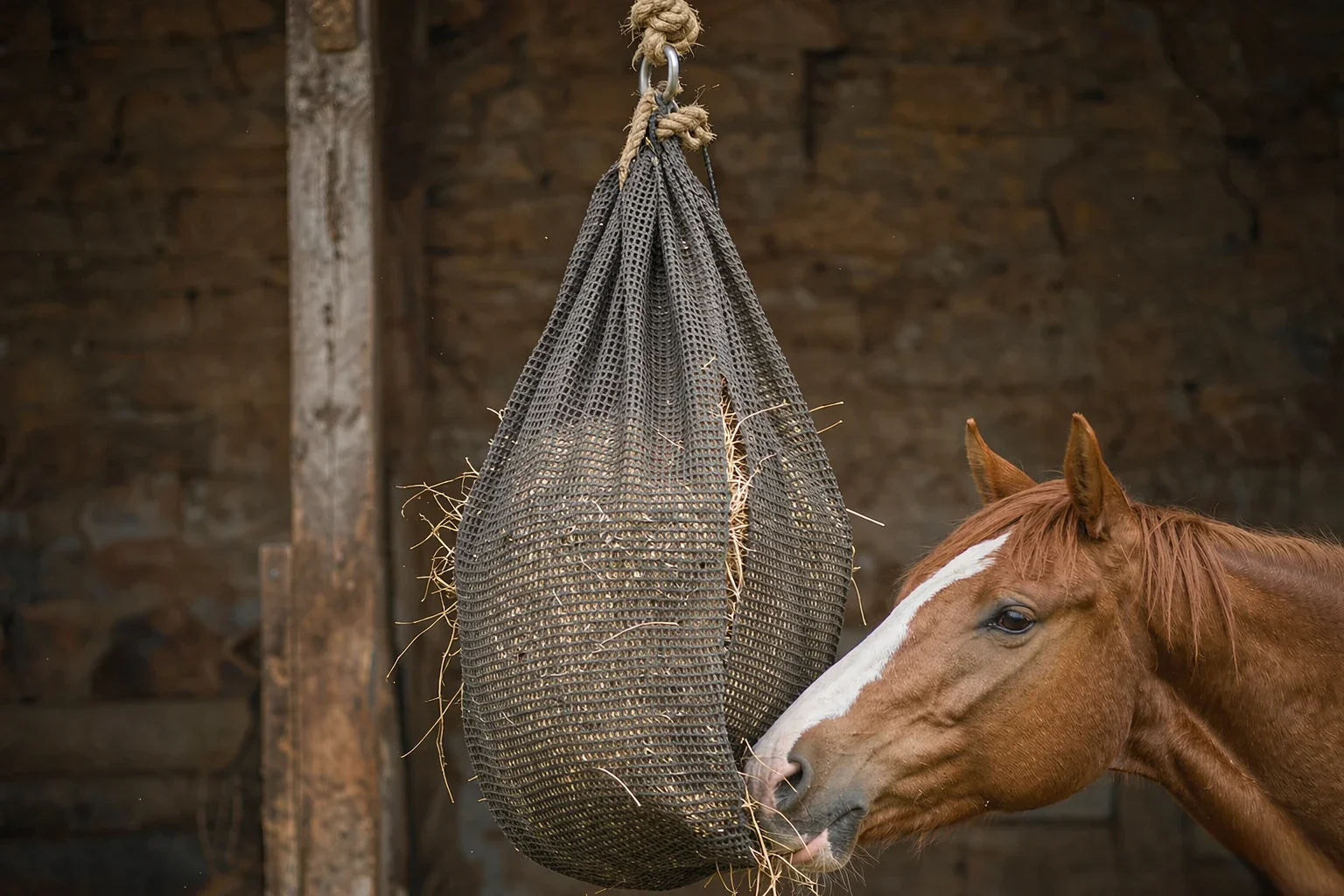
Slow-feed hay nets address all of it with one $25–$50 purchase. The mechanism is simple: smaller holes mean smaller bites, which stretches the same flake over more hours, keeps saliva and buffer flowing into the stomach, and drops waste dramatically. This guide covers net types, hole sizes, safety rules, and the arithmetic on how fast they pay for themselves.
Hole Size: The Only Specification That Matters
| Hole size | Eating rate (flake of hay) | Best for | Watch out |
|---|---|---|---|
| 4–6 in (loose net) | 1–2 hours | Transition, horses new to nets | Barely slows eating |
| 2 in | 3–5 hours | Most adult horses, daytime | Good starting point |
| 1.5 in | 5–8 hours | Easy keepers, overnight | Frustration risk for some horses |
| 1–1.25 in | 8–12+ hours | Strict weight management | Vet/dentist check first; teeth must be sound |
Start at 2 inches. If the horse finishes it too fast, step down to 1.5 inches. Do not start at 1 inch: a horse that cannot extract hay fast enough to feel OK will either give up (weight loss) or develop stereotypies (weaving, pawing). The transition takes 1–2 weeks and the horse’s teeth need to be in good shape before you start — an old horse with sharp points will struggle on any net.
Net Types Compared
- Standard hay net (42–48 inch) — the classic. Tie high, fills 2–4 flakes. $15–$30. Rope loops at both ends take the most abuse.
- Slow-feed net with 2” or 1.5” holes — same shape, finer mesh. $25–$45. The workhorse for stalls and runs.
- Round-bale slow-feed covers — a fitted net over a round bale, turns a 3-day bale into 5–8 days and cuts waste by 30–50%. $80–$180. The single best money-saver for a herd on round bales.
- Grazing muzzles with net inserts / ground hay pillows — for horses that need slow feeding from ground level, which is better for the neck and respiratory posture anyway. $40–$90.
- Wall-mounted slow-feed boxes — rigid frame with a net face. No rope to tangle, best for hard keepers of nets. $90–$200.
Safety: The Rules That Are Not Optional
Hay nets injure and kill horses every year, and almost every incident involves one of three failures:
- Hung too low. A net hung at chest height or lower invites a hoof in the mesh. Hang it at wither height or higher — the horse eats slightly downhill or level, never reaching down into a bag.
- Wrong rope. Use breakaway cord rated to snap under a horse’s weight, never baling twine or a stiff hay string that will not release if the horse panics.
- Two competing horses in one small area. A net is a resource; two horses with a dominance imbalance will fight over it. One net per horse, far enough apart that both can eat at once.
Barefoot horses in bell boots, and horses with shoes on the hind, are the highest-risk group for a hoof caught in mesh. If your horse is shod behind, either hang nets very high or use a rigid slow-feed box instead.
The Waste Arithmetic
Loose hay on the ground gets trampled, manured on, and used as bedding. Measured waste for ground-fed hay runs 15–30% of what you put out; the same hay in a slow-feed net runs 5–10%. For a horse eating 18 lb of hay a day at 2026 hay prices of roughly $12–$18 per 45-lb bale:
| Feeding method | Waste | Hay cost/month | Waste cost/month |
|---|---|---|---|
| Ground, loose | 25% | $145–$216 | $36–$54 |
| Slow-feed net | 8% | $145–$216 | $12–$17 |
| Savings | — | — | $24–$37/month |
For a 10-horse boarding barn feeding round bales, the slow-feed cover arithmetic is bigger: 30–50% less waste on a $75–$120 bale is $25–$60 per bale saved, which on 8–10 bales a month is $200–$600/month from a $150 net cover.
Common Mistakes
- Going too fine too fast. The 1-inch net that solves weight problems also causes a frustrated horse to stop eating entirely. Step down gradually.
- Ignoring dental status. A horse that quids or drops hay on any surface will struggle with fine nets. Get the teeth checked first.
- Not weighing the result. If you are slow-feeding for weight loss, weigh the horse (a weight tape every two weeks, same time of day) or you are guessing.
- Refilling too often. The entire point is to stretch forage across hours. A net emptied in 90 minutes means the holes are too big or you are putting in too little hay.
- Leaving broken mesh in service. A torn net becomes an entanglement hazard and a whole-mouth feast at once. Repair or retire it.
Beyond the Net
- Corner hay bag — Two net stations, zero boredomCheck Price
- Automatic hay feeder — Timed drops while you sleepCheck Price
- Heavy-duty duct tape — Every net dies eventuallyCheck Price
The Discipline Rule
Slow feeding changes the horse’s schedule, so check the horse’s condition on the new schedule rather than assuming the old one. Body condition score monthly on the 1–9 scale: you want the ribs to be palpable with light pressure, not visible, not buried. Easy keepers losing weight too fast on a 1.5” net should step back up to 2”, and hard keepers dropping weight on any net need more total forage, not smaller holes.
Match total forage to the horse, not the net. The net changes when the horse eats; it does not change how much the horse needs. An 1,100-lb horse in light work still needs 15–20 lb of hay a day — the net just delivers it over 14 hours instead of 4.
Slow feeders by use case
- Small-hole net (1 inch) — For cresty-necked easy keepers and any laminitis historyCheck Price
- Standard 1.75-inch net — The all-round default for most pleasure horsesCheck Price
- Paddock slow feeder — For groups — reduces competition and spread-out wasteCheck Price
- Hay net for trailer — Travel feeding without loose hay in the trailerCheck Price
Guides
Gear & Reviews
Popular Reads
Keep reading: How much hay does your horse need? Per-month math